
Book Review
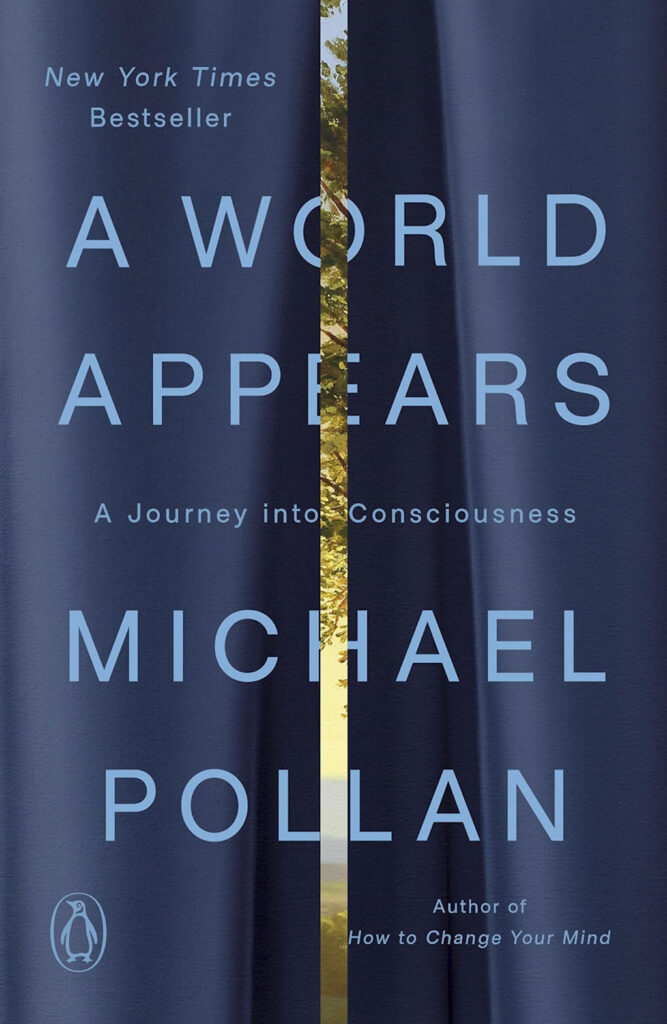
A World Appears
A Journey Into Consciousness
Michael Pollan | Penguin Random House | 2026
Review by Denise Winn
In A World Appears, Michael Pollan traces the unmapped continent that is consciousness, bringing radically different perspectives—scientific, philosophical, literary, spiritual, and psychedelic—to see what each can teach us about this central fact of life.
Consciousness: we all have personal knowledge of it and yet, as this author soon discovers, there isn’t even an agreed definition for it. The renowned Francis Crick, challenged by a philosopher as to what exactly he hoped to explain from a scientific study of consciousness, was reduced to mumbling that it wasn’t a good idea to define one’s research targets too precisely too early.
Theories to explain this undefined thing are legion, however: from the reductionist (integrated information theory, global neuronal workspace theory) to the expansive and metaphysical (panpsychism, idealism, illusionism and quantum theory)—indeed, we learn that there are no fewer than 84 of the latter. Philosopher Daniel Dennett draws his line between “competence” which may be possessed by plants, insects, viruses, whatever, and “comprehension” which may not. Karl Friston, physicist, neuroscientist and psychiatrist, believes “inference” is the key—as organisms, we must predict and infer things to help us maintain homeostasis: it is inference that involves constructing images of ourselves and the world, to help us make our predictions.
All this is introduced and unpacked slowly as we accompany Pollan, cogitating and fretting over what he learns from the host of different scientists and thinkers that he spends time with, delving deeply into their different approaches to pinning down the elusive.
We learn early on that a scientific approach to consciousness is not even as “objective” as it is cracked up to be. It was Galileo who set the path down which scientific enquiry travelled in this matter. He had divided nature into primary qualities that are measurable, such as shape, mass and motion, and secondary qualities that are subjective, such as taste, smell and sound—and decided science should confine itself to studying only the former, lest it risk incurring the wrath of the Church, which considered immeasurable things to do with mind or soul to be its personal property. This meant reducing lived experience of, say, color and sweetness to specific light frequencies and glucose molecules. Mathematical abstraction gradually elbowed out lived experience. It was safer that way.
Another limitation of the scientific method is hubris. There has been consistent underestimation of the abilities of other species, mainly because scientists have devised tests that focus on skills which humans have. For instance, sense of self has commonly been judged by the mirror test—toddlers seeing in a mirror an image of themselves with a sticker on their forehead will reach up to remove it, thus showing that they recognize themselves. Creatures such as apes, dolphins, orcas and magpies have all “passed” the mirror test. But this biases against animals who do not rely so predominantly on sight. There is now a mirror test for dogs that is based on scent. Philosopher Evan Thompson also despairs of Western science’s failure to acknowledge that subjectivity is present in science from the start, right down to how problems to investigate get chosen and then framed.
But there is still much to learn. Pollan decides to begin his search at the “bottom”—with living organisms that most scientists would not deem conscious at all: plants. Experiments show that plants can learn and form memories (one tropical plant which normally folds its leaves instantly when touched, to prevent being eaten, was taught not to react this way when its pot was dropped and could remember that for 28 days). Plants can choose to dig deep into soil in which nutrient levels are increasing, rather than soil in which nutrients are available only for a short time; unrelated plants will compete for nutrients, whereas related plants are happy to share the same pot; if an obstacle looms or a toxin threatens, their roots can change course before making contact with it. Plants can integrate information from over 20 distinct “senses,” including our own five, and can even be rendered unconscious by anesthesia, which rather implies something about its opposite. Plant scientist Stefano Mancuso thinks neurons—the nerve cells that carry electrical signals like sensations, movement and commands throughout the body—are definitely overrated.
Even, bacteria, viruses and single- and multicellular creatures may have consciousness, some biologists aver. Distinguished biologist Michael Levin taught a tiny flatworm a simple task, then chopped off its head. When it regrew its head (as it can), it could still remember the task, indicating, says Levin, that the memory had been stored not in its brain but in its body, in the bioelectric field (or network) that he has established links cells.
His head reeling, Pollan moves on to explore the role of feelings in consciousness and encounters more hard questions. To have feelings, do you have to have a body? Oddly—or perhaps not oddly, given the history—feelings don’t figure so much in theories of consciousness. Pollan interviews the celebrated neurologist Antonio Damasio, who started to change this, positing feelings as the bridge between mind and body. Far from the body being around to support the brain, he was at pains to show, the brain’s role is to support the body—indeed, a prime feature of the brain is to keep the body functioning optimally, orchestrating temperature, blood pressure, blood chemistry, etc. Damage to the cortex has little impact on consciousness, whereas damage to areas of the upper brainstem, which monitors such signals from the body, will close down consciousness completely. As Pollan later muses, it is a paradox within computer science that the “higher” capabilities such as reason, language and intelligence, which we think of as uniquely human, are easier for machines to simulate than basic feelings and emotions.
Pollan’s discussions with the variety of scientists and philosophers he encounters consistently throw up new conundrums—indeed, the more he learns, the less he feels he knows. And so it is when he meets South African neuroscientist and psychoanalyst Mark Solms. Solms holds that uncertainty, the mental equivalent of entropy, is the enemy of homeostasis (the body’s maintenance of a stable internal environment necessary for survival). The uncertainty generates feelings, and feelings generate the consciousness to predict how to eliminate the uncertainty that is affecting homeostasis. He thinks that the ultimate goal of mind is to “render consciousness superfluous by reducing uncertainty to zero and putting maintenance of life on autopilot.” He is trying to prove this rather dismal hypothesis by building a conscious form of AI, with competing needs and homeostatic set points that he hopes will generate feelings and, therefore, consciousness. “If consciousness is subject to causal mechanistic explanation, as I believe it is, then we should be able to engineer it,” he says. Quite an unexpected statement from someone who is also a psychoanalyst—or perhaps not; an 88-page 2023 report by nineteen leading computer scientists and philosophers has concluded that “there are no obvious barriers to building conscious AI systems.” Solms has marshalled an international team of computer scientists, roboticists and physicists to help him prove he can overcome any hidden ones. (Some other AI researchers think creating conscious AI is a moral imperative, because conscious machines are more likely to have empathy—an interesting position, given current concerns about AI systems going rogue.)
But what about the contents of consciousness? It is to thoughts that Pollan turns his attention next and subjects himself to a grueling experiment still being run (after more than 50 years) by psychologist Russell Hurlburt, using a beeper Hurlburt developed to sample people’s random thoughts. It sounds simple. The beeper goes off and you note down what was in your mind at the time. However, as Pollan discovers, Hurlburt is highly prescriptive—when Pollan reports being in a queue at a local café and smelling the cheese and bread smells, Hurlburt wants to know if he was aware of the smells before the beep or after. And when he reports seeing something, he is immediately asked what angle he saw it from and so forth. Suddenly Pollan isn’t sure about anything. Indeed, Hurlburt agrees that his most important finding, after all this time, is how little most of us know about the characteristics of our inner experience. It cannot be ignored that this is a highly reductionist approach to the investigation of something so fluid and intangible—and it seems that Hurlburt cheerfully agrees.
Pollan goes on to explore the wandering mind (apparently even highly experienced mindfulness practitioners have their mental stillness infiltrated by an errant thought every 10 to 20 seconds), streams of consciousness and much else besides, before moving on to tackle “the self.” There are so many conundrums. How can we possibly observe the “self,” when it is like making the subject into the object? And if we cling to the idea of self so strongly, how come we are so keen to transcend it? And if consciousness needs a self, what explains the selfless experience brought about by psychedelic drugs? Neuroscientist Anil Seth thinks the self is a prediction and our perceptions all controlled hallucinations. Pollan is perplexed. How can he have hallucinated the unknown room in Seth’s house where they are taking tea? Seth claims that so many elements of the room are universal—the angles, the objects—and I was disappointed that Pollan lets it go at this. How would Seth explain Pollan “hallucinating” the exact same teacup that Seth has himself “hallucinated”? Or perhaps it is the word “hallucinate” which is troublesome. When Seth suggests that the brain constructs a perception of the self from sensory information coming from inside us, not outside, and that emotions, such as fear, are the brain’s best guess to explain a rise in heart rate, we are, for me, on safer ground.
Alison Gopnik, a leading authority on child development, introduces Pollan to the concept of lantern consciousness (“that vivid panoramic illumination of the everyday” experienced in childhood) which gradually gives way to spotlight consciousness, once children are taught to sit still, concentrate, plan, exert willpower and focus on specifics. Later Pollan meets philosopher Thomas Metzinger, who talks to him about “pure awareness” and a self-less state of consciousness. Yet curiously, to me, Pollan mentions the polymath Iain McGilchrist only in an endnote, as a proponent of French philosopher Henri Bergson’s idea that the brain is a receiver rather than an originator of consciousness. McGilchrist has, in the last decade or two, compellingly explained how spotlight and lantern consciousness are the province of the left and right hemispheres of the brain respectively, and how what we pay attention to changes what we bring about in the world. Even more surprisingly, these two different types of consciousness were being studied and written about by psychologist Dr Robert Ornstein as far back as 1972 in his transformative book The Psychology of Consciousness (later fully revised to incorporate new understandings). In his posthumously published God 4.0, he linked the latter form of consciousness scientifically to an innate second system of perception, quiescent in most of us but capable of development, and to the possibility of the mind connecting with a higher consciousness.
As Pollan says, the mysteries remain but he is conscious of so much more than before he set out on the book.
Denise Winn is a writer, journalist and psychotherapist. She is author of The Manipulated Mind: Brainwashing, Conditioning and Indoctrination, and is a human givens practitioner.
McGilchrist, I. The Master and his Emissary: The Divided Brain and the Making of the Western World. Yale University Press, 2009.
McGilchrist, I. The Matter with Things: Our Brains, Our Delusions and the Unmaking of the World. Perspectiva Press, 2021.
Ornstein, R. The Psychology of Consciousness. W. H. Freeman and Company, 1972.
Ornstein, R. The Psychology of Consciousness. Penguin Books, 1986.
Ornstein, R. with Ornstein, S. M. God 4.0: On the Nature of Higher Consciousness and the Experience Called “God.” Malor Books, 2021.