
Book Review
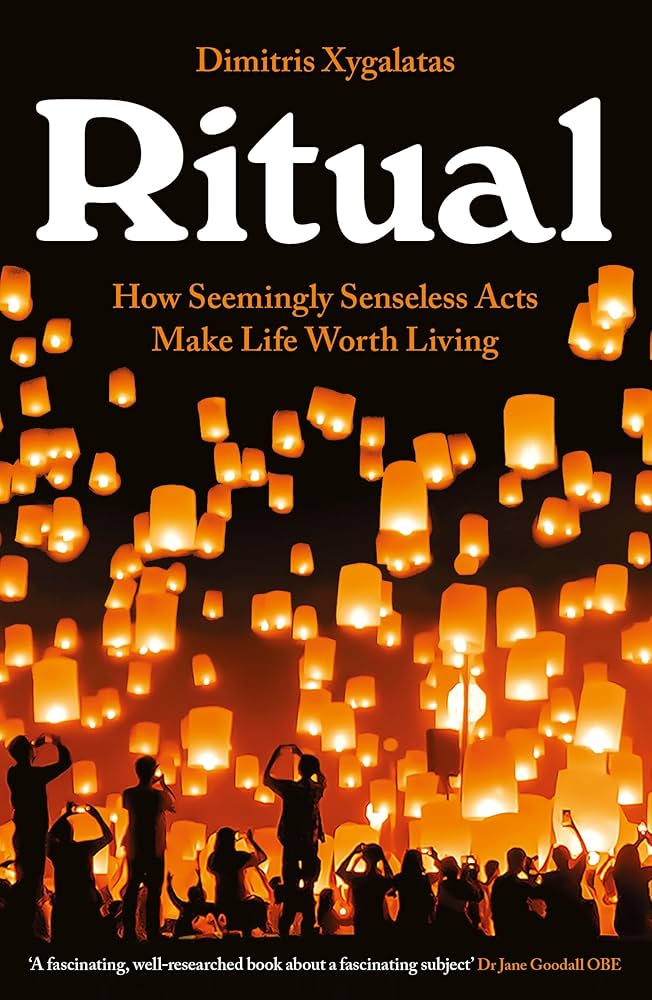
Ritual
How Seemingly Senseless Acts Make Life Worth Living
Dimitris Xygalatas / Profile Books / 2024
Review by Denise Winn
Anthropologist and cognitive scientist Dimitris Xygalatas explores a multitude of “seemingly senseless acts” to find out why, however sophisticated societies may become, we cling to many ancient rituals, often unquestioningly.
What does former tennis ace Rafael Nadal, lining up his water bottles just so before a match, have in common with a Pentecostalist dancing ecstatically with deadly snakes, or a judge using a gavel to call for order in court? They are carrying out rituals, symbolically meaningful for them all, yet totally unnecessary as regards the hoped-for outcomes of their actions.
The subhead of anthropologist and cognitive scientist Dimitris Xygalatas’s riveting book says it all: he presents us with a fascinating exploration of a multitude of “seemingly senseless acts” to find out why, however sophisticated societies may become, we cling to so many ancient rituals, usually unquestioningly. As he puts it, habits such as tooth brushing are “causally transparent” whereas rituals—for instance, making swooping movements in the air before brushing—are “causally opaque.” Habits allow us to act routinely and unreflectively, whereas rituals require focus and attention. He proceeds to unpack exactly what all this means for us as a species.
Xygalatas’s interest in ritual and the human needs it fulfills developed from his decision to investigate extreme rituals for his PhD. This led to an abiding interest, which led him to travel across the world for the next two decades, carrying out fieldwork, living with local communities, witnessing countless seemingly pointless ceremonies, interviewing those performing and those watching them, and conducting his own research. As a result, he is convinced that rituals, however bizarre or apparently ridiculous, can have transformative power.
It is not only humans that perform obscure rituals. Xygalatas introduces us to, for instance, the tango-like love dance that giraffes perform when courting; the elaborate ceremony carried out by crowds of flamingos as they pick their sexual partners, often for life; the rhythmic waterfall dance of chimpanzees, observed in Tanzania by Jane Goodall; and the complex behaviors of elephants in the event of deaths.
Xygalatas makes the case that we have an innate need for ritual. After all, children seem to sense this from a very young age, developing their own precious routines, such as kissing cuddly toys in a particular order before bedtime, which, if thwarted, could lead to tantrums.
Quite clearly, as Xygalatas gives many examples to show, carrying out rituals strictly to the letter appears to increase our (otherwise flimsy) sense of control over circumstances that we cannot really influence. Anthropologists studying the apparently extraordinary behaviors of some of the inhabitants of the Trobriand Islands gradually recognized that rituals, such as casting complex magical spells, making elaborate food offerings, wrapping an ax blade in special herbs before cutting logs to be used for making a canoe, etc., were performed only in areas where outcomes were highly uncertain—such as the yield for vegetables planted in a particular soil highly vulnerable to disease, or setting out to fish in dangerous waters. “In the case of ritual, the causal links may be illusory, but the action may still have therapeutic value,” he says.
Thus, rituals may be helpful for our mental health. Conversely, ignoring the rigidity required for their performance can be downright harmful. Xygalatas tells the eye-opening story of Reverend Matthew Hood, who had been happily serving as a pastor in a parish in Utica, Michigan, when he happened to go through family videos and found one of his own baptism. The deacon had said, “We baptize you” instead of “I baptize you.” This deviation from the required wording worried him enough that he sought advice from theologians and canon lawyers, and this eventually led to receipt of a statement from the Vatican saying that the wording invalidated Hood’s baptism and thus also his ordination as a deacon and a priest—and, worse still, all those who had been ordained by him were not legitimate clergy either. Ironically, those who had been baptized by him were okay, as anyone can baptize someone—as long as they use the right words! To me, this seems to be taking things a tad too far—surely, circumstances alter cases—but perhaps that would undermine the power of ritual, if correct performance can be discarded when not convenient.
It is the often unlikely nature of ritual that confers an important aspect of its power. As Xygalatas points out, when observing a ritual for the first time, we cannot intuit what is going to happen. This flummoxes our predictive brains. Over the last decades, research has shown that our brains keep our bodies functioning efficiently by predicting what is going to happen (based on previous experience) and “reacting” in advance, or updating our knowledge base in the light of new experience. So we see in the distance someone who causes us anxiety and, before we arrive at the point where we have to say hello and engage in an unwelcome conversation, our systems have gone into fight-or-flight mode, ready to take evasive action to save ourselves from distress. Or perhaps we don’t recognize that the steps of a staircase are steep, take one misstep and then quickly readjust our foot movements to accommodate the wider distance between risers. However, ritual doesn’t make sense, so we can’t infer. We have to pay attention. And that can make what we are seeing or performing feel very special.
In another telling story, Xygalatas recounts how researchers showed 474 study participants two versions of a film of a man pouring a drink into a glass. In one version, he picked up the glass, cleaned it with a cloth, poured the drink into the glass and checked it as he set it down on the table. In the other, he carried out the same actions—but added some extraneous ones. After picking up the glass, he flapped the cloth at it before touching it to clean it, raised the drink high into the air before pouring it into the glass and bowed to the glass before setting it on the table.
All the participants agreed that there was no difference between the two glasses of liquid. Yet, when asked whether one of them was more special than the other, they chose the ritually poured drink—and were three times more likely to opt for it, if given the choice. It was their perceptions that were altered, and this effect was even stronger if they were told that the actions were part of a traditional ceremony carried out in some faraway land; participants were twice as likely again to pick the “special” drink.
Xygalatas goes into enormous (often somewhat gruesome) detail about the requirements of many extreme religious rituals—such as the fire walking carried out every year in the Spanish village of San Pedro. His research team was able to fit participants, and those watching, with heart monitors and other measuring devices to see what actually happened to them physiologically when walking (or watching others walk) barefoot over burning coals. To the researchers’ amazement, they found strong synchrony between the heart rates of participants and observers—but only with the observers who were local, not outsiders present just for the spectacle. For the former, the event was personally meaningful and that was what made the difference. Also, the closer the relationship between participants and observer, the stronger the synchrony.
Other rituals described include the horrendous-sounding coming-of-age ceremony carried out by a tribe deep in the Brazilian Amazon rainforest: boys becoming men had to briefly don gloves into which had been woven a hundred agitated live bullet ants, ready to deliver stings of a paralyzing neurotoxin, the pain of which has been described as similar to being shot (thus their name), walking on three-inch nails or, indeed, like walking over flaming coals.
And then there is the Thaipusam, an excruciatingly painful and protracted pilgrimage undertaken in honor of the Hindu god Murugan, carried out by Tamil communities in various parts of the world. Devotees make their way steeply uphill to a temple, carrying heavy shrines on their backs and/or with their bodies pierced by hooks from which they hang bells, or with spikes penetrating the entirety of their skin, or needles through the tongue or inserted through one cheek and out of the other. Far from causing collapse and infection, Xygalatas’s research shows, those who participated suffered no physical ills and enjoyed enhanced psychological health. And those who attended the festivities and supported the courageous participants experienced a heightened sense of community and a greater tendency towards prosocial actions. Indeed, anthropologists have observed that societies most reliant on social solidarity to survive and thrive are those that organize the most dramatic kinds of ceremonies.
The euphoria that accompanies the carrying out of demanding rituals, Xygalatas comments, makes them particularly beneficial for people in such communities who are suffering from depression. Deeply depressed people lack the motivation to take exercise, spend time with others, etc.—the very things that could help them. However, the need to do so as part of a sacred ritual can make engaging in such activities imperative—or at least more probable.
It is not just more primitive communities that rely heavily on ritual; nor do the rituals we carry out today all have their roots way in the past. Many new rituals developed across the world in the reaction to the unprecedented (to us) COVID-19 epidemic, when everything felt threatening and uncertain. Apparently Google searches for prayers surged to an all-time high over this period. And, in one neighborhood, residents overcame social distancing by using bamboo sticks fashioned with cup-holders, so that they could still clink glasses with neighbors.
“The new kinds of ceremonies that emerged during the coronavirus pandemic reveal an important truth about rituals,” writes Xygalatas. “While they typically resist change, they serve functions that are much too important for humans to live without, and as such they can be quick to adapt when new circumstances demand it.” And if, as he suggests, the COVID-19 pandemic has shown graphically how fragile our modern existence can be, then “we may find that we have ever greater recourse to the powers of ritual, to give us peace of mind, foster solidarity and provide a sense of meaning and continuity.”
Denise Winn is a writer, journalist and psychotherapist. She is author of The Manipulated Mind: Brainwashing, Conditioning and Indoctrination, and is a human givens practitioner.