
Book Review
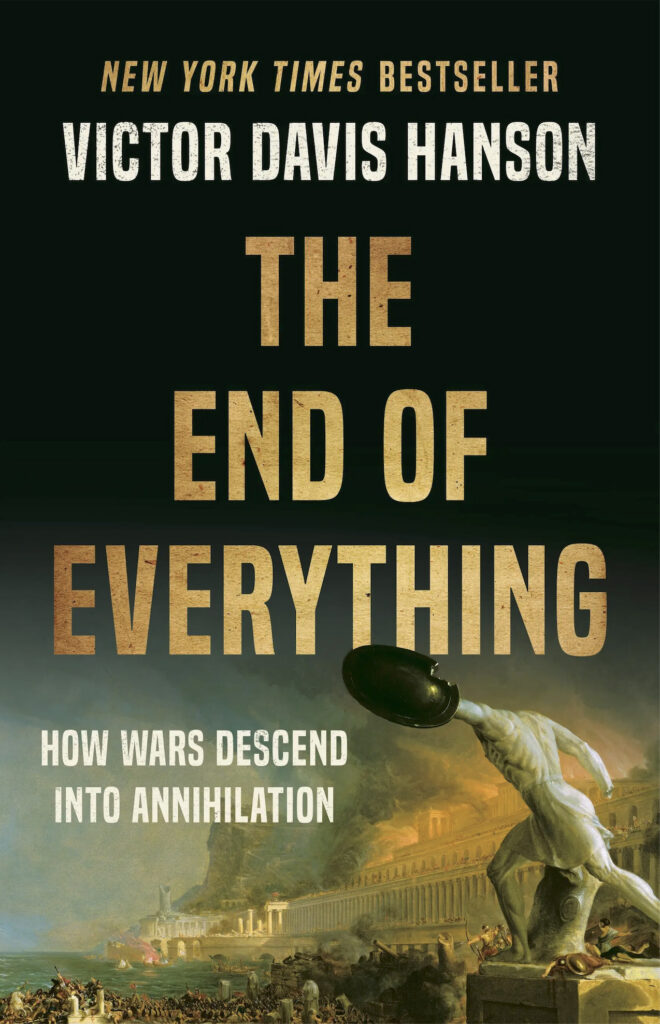
The End of Everything
How Wars Descend into Annihilation
By Victor Davis Hanson / Basic Books / 2024
Reviewed by John Zada
The American classicist and military historian Victor Davis Hanson looks at a particular type of armed conflict, the “war of annihilation”, in an attempt to better understand how and why sophisticated and successful societies found themselves in showdowns that were not just unwinnable, but unsurvivable.
In 146 BC, following a grueling and costly three-year military siege, a large Roman army led by Scipio Aemilianus breached the walls of the Punic city of Carthage, on the north coast of what is modern-day Tunisia. During that final weeklong assault, Roman fighters systematically destroyed the city and butchered nearly all of its inhabitants. Aemilianus’s forces took the remaining 50,000 emaciated and bedraggled survivors of the city prisoner, eventually selling them into slavery. Rome’s once formidable Mediterranean rival empire was effectively destroyed. Within months the conquered Carthaginian territories became the newly declared Roman province of Africa. Over a century later the Roman emperor Augustus, completing a project Julius Caesar had abandoned, rebuilt Carthage as a Roman city, wiping away the last vestiges of Punic culture that hadn’t already been scattered to the winds.
The Third Punic War, as we call it today, came as a stunning surprise to the Carthaginians. Prior to it, they had valiantly fought, but lost, two devastating wars for control of the central and western Mediterranean against an expansionist Roman republic. Following those conflicts, Carthage acquiesced politically and militarily, posing less of a threat to its Italian neighbor. Relations became somewhat cordial with time. But when the Carthaginians violated one of the terms of their surrender by defending themselves militarily against a hostile North African neighbor and ally of Rome, the Romans decided that they’d had enough of Punic headaches.
Some hawkish Roman senators, traumatized by the memory of Rome’s past wars with Carthage (including 16 years of Hannibal and his elephants), and who had long called for Carthage to be wiped off the map, now pressed their case even harder. Their southern neighbor, they argued, though still diminished militarily, remained a prosperous mercantile power that could rise again to be a thorn in their side. Those voices won out.
Instead of reprimanding them for violating their treaty, the Romans served Carthage with an intolerable ultimatum: completely disarm, destroy all of your ships, and relocate your city and population inland. This harsh order, whose intended noncompliance was meant to be a casus belli for total war, was naturally spurned by the Carthaginians—maritime traders, who could no more imagine abandoning the sea than rebuilding their illustrious and heavily fortified capital stone by stone. Better to try their luck resisting than shamefully agreeing to vanish into irrelevance.
When the Carthaginians agreed to some terms, but not others, many of them thinking that the Romans were just hard bargaining, the Italians sent their invasion force across the Mediterranean. The rest is history, as the expression goes.
This conflict, one of countless wars in human history, holds a particular significance. For one, the Punic defeat marked the removal of the last obstacle to Roman dominance of the western Mediterranean, accelerating Rome’s transformation from republic to imperial power. In addition, the illustrious empire, people and culture of Carthage suffered a rare eradication. It had been effaced. The Third Punic War was a conflict of obliteration, a special category of military defeat in human history.
In his book The End of Everything: How Wars Descend into Annihilation, American classicist and military historian Victor Davis Hanson examines these types of conflicts in an attempt to better understand how and why sophisticated, successful societies found themselves in wars that were not just unwinnable, but unsurvivable.
The reason for familiarizing ourselves with these cases, he tells us, is that wars of annihilation, which result in the complete eradication of peoples and cultures from a place, though rare, are still at risk of happening today. The tenacity and intensity of current conflicts in Israel-Palestine, Iran, and Ukraine speak to that possibility, as do more seemingly distant possible wars, including a conflict between the two Koreas, India and Pakistan, and the US and China over Taiwan. If we can understand the hallmarks of the impulse to wage total war, we may stand a better chance of seeing it coming and avoiding it.
Our civility, material success, and technological savvy in modern times creates an illusion that such scenarios of extermination are a thing of our unsophisticated past. Yet there is always a chance that weaker parties to a conflict may still resist stronger aggressors, who might find themselves tempted, under certain circumstances, to annihilate their opponents beyond achieving victory. Material and technological advancement even increases this risk, since wars today have the potential for far greater destruction and can be waged ever more remotely and impersonally.
“Modern civilization faces a toxic paradox,” Hanson writes. “The more that technologically advanced mankind develops the ability to wipe out wartime enemies, the more it develops a postmodern conceit that total war is an obsolete exercise, given that disagreements among civilized peoples will always be arbitrated by the cooler, more sophisticated, and more diplomatically minded. The same hubris that posits that complex tools of mass destruction can be created but never used, also fuels the fatal vanity that war itself is an anachronism and no longer an existential concern…”
Hanson illustrates three other military case studies from the historical record:
(1) The destruction of the Greek city-state of Thebes by Alexander the Great in 335 BC;
(2) Ottoman Sultan Mehmed II’s sacking of Constantinople and the fall of the Byzantine empire in 1453; and
(3) Spanish conquistador Hernán Cortés’s destruction of the Aztec Empire in 1521.
With dramatic flourish, using the memorable characters at their heart, Hanson retells the story of these conflicts and their convoluted origins in all of their colorful and vivid detail.
The Greek city-state of Thebes, which had rivaled both Athens and Sparta in cultural and military achievements, decided to stand up to Alexander the Great and his Macedonian army when the latter decided to conquer all of the Greek city-states and eventually Asia. The Thebans believed they could lead and spark an uprising among their Greek sister cities that could halt Alexander in his tracks.
The rising tide of the Ottoman Turks, slowly inundating the long-surviving but increasingly archaic Byzantine Empire, reached the legendary reinforced walls of Constantinople: the jewel in the crown conquest and would-be Turkish capital. The wily Byzantines, who had exceptional defenses, believed they could keep the Turks (and Islam) at bay until the Europeans could successfully come to their aid.
The Aztecs at their capital of Tenochtitlan in modern-day Mexico, numbering in the millions, did not take the initially friendly few thousand Spanish conquistadors who arrived at their doorstep to be an existential threat. This was reinforced when Cortés and the Spanish overstayed their welcome and were surprised and temporarily repelled by the Aztecs. The Mexicans were confident that the Spanish, with their strange and unusually powerful weapons and animals of war, were gone for good.
But in each and every one of these cases, including with the Carthaginians, the defenders, contrary to their expectations, were completely overwhelmed and eradicated. Like the Carthaginians after them, the people of Thebes, killed or sold into slavery, disappeared after their city was razed. The Greek Byzantine culture of Asia Minor was dealt a crippling blow by the Ottomans. Their descendants were dispatched or sent packing in the massacres and population exchanges with Greece under Turkish president Kamal Ataturk in the 20th century. The Aztecs, of course, were also eradicated as a culture and society, although individuals survived and became part of the new societal and genetic amalgam that became Mexico.
Hanson, by way of his narrative and analysis, reveals certain patterns present in each case.
The vanquished, he shows us, were once powerful, glorious entities which had fallen into decline, and whose defeat and collapse were partly the result of long-unaddressed vulnerabilities. Their economic, political and social fissures widened under the pressures of war. But just as importantly, a powerful degree of naivete, hubris and miscalculation veiled them from the more sober realization of their plight and eventual ruin.
The victors, by contrast, were all powers on the rise. They benefited not only from military genius, but also from the momentum of new technologies, tactics, and motivating ideologies or passions. Furthermore, they all shared desires or plans in which the annihilation of their opponents worked to their benefit—and which their victims were completely ignorant of before it was too late.
“The doomed were beguiled by unrealistic appraisals of their own strength,” Hanson writes, “oblivious to the obvious signs of their own decline, naively encouraged by the rhetoric of their supposedly rock-solid allies, clueless about the asymmetry of assets in the war that loomed, and fooled by the honey-tongued seeming reasonableness of the men who would shortly destroy them.”
In every case, the imperiled not only put up a creative, stubborn, or momentarily surprising defense that came close to saving them, but also, through acts of spite, goaded their enemies into completely eradicating them. The Thebans fought like berserkers against the Macedonians, inflicting heavy losses upon them, and personally mocked and insulted Alexander—even after he expressed his willingness to deal leniently with them, fueling his infamous ire. The Aztecs’ weakness in warfare vis-à-vis the Spanish was that they fought primarily to capture prisoners to sacrifice—not to kill on the battlefield. Many of Cortés’s unfortunate soldiers were sacrificed alive, having their hearts torn out of their chests atop pyramids for all to see, causing the Spanish to not only want to wipe out Aztec culture, but all of Mesoamerican civilization.
“The fierceness of the doomed grew with bleaker odds,” Hanson says, “but such fanatical resistance only guaranteed the mercilessness of the victors. The zeal necessary to resist overwhelming odds eventually ensures a level of counterviolence that seals the fate of the defeated.”
Interestingly, as with the destruction of Carthage which cleared the way for the eventual Roman conquest of the Mediterranean, the total elimination of one party marked the end of a regional and/or global order that made way for another. Alexander’s smiting of the Thebans ended the classical Greek era of independent city-states and inaugurated the Hellenistic era of imperial kingdoms and values; Sultan Mehmet II’s conquest and transformation of Constantinople into the Ottoman capital marked the decline of the Mediterranean world as the nexus of European commerce, creating an Atlantic seafaring impulse dominated by Portugal, Spain, France, Holland and England; and the obliteration of Tenochtitlan by Hernán Cortés normalized the crushing of indigenous civilizations in the Americas and birthed a new Spanish-speaking empire there that fused the two.
Although Hanson doesn’t say as much, these civilizational shifts following each war may not have just been a consequence of military annihilation, but also a pre-existing hinge point that helped to draw out those catastrophic endings. Thus, perhaps wars of annihilation might be more likely at the end of epochs, whose ends the victors sense and hope to extinguish more fervently.
Hanson reminds us repeatedly and bluntly that his case studies are relevant to the present. Intense and potentially murderous rivalries, marked by the rise and fall of powers, continue to this day. He adds that much of the reckless behavior of current combatants mimics the unwise decisions found in The End of Everything.
“Hamas attacked and murdered in part because it never believed Israel would virtually destroy Gaza or that the world would allow that to happen,” he writes. “It should have read about the repeated warnings to Carthage from the Roman Senate . . . Ukraine does not fully believe that its missile attacks on Russia or its counter-invasion of the Russian homeland would ever prompt Putin to reply with a tactical nuclear weapon—an odd assessment of the seriousness of a belligerent that lost more than one hundred thousand lives defending Crimean Sevastopol from the same Wehrmacht that had already killed or captured seven hundred thousand in the 1941 encirclement of Ukrainian Kyiv.”
Hanson’s book is fundamentally about the need to question our assumptions at the political and geopolitical levels in an age of potential mass human extinction. What is the durability of the status quo? What is an acceptable price to pay to try to keep one’s foes at bay? What is the actual strength of the enemy? How reasonable is one’s course of action? Are we really as powerful as we think we are, or once were? Is the era of nuclear annihilation we faced during the Cold War really over?
The chance to foresee and adapt to a new reality, and to survive, was hampered in every one of Hanson’s cases by the assumption and reflex—still alive in some military cultures today and in the stubborn politico ego—that death and sacrifice, even of one’s own culture or society, is preferable to defeat. That mentality is summed up in the expression, quoted by the Mexican guerrilla leader Emiliano Zapata, “It is better to die on your feet than to live on your knees.”
Hanson writes: “Statesmen and revolutionaries alike have for twenty-five hundred years quoted or paraphrased the famous line of the wretched Io in Aeschylus’s Prometheus Bound, who laments that ‘it is a better thing to die once than to suffer terribly all of one’s days’ . . . But however noble the sentiment, such courageous fatalism is often wise advice only to the strong, or to those at least with some confidence in victory. For the vulnerable, dying ‘once’ on your feet can mean ensuring the torture, enslavement, or slaughter of the young who have not yet learned to walk.”
John Zada is a writer and journalist based in Toronto, Canada. His latest book is The Patchwork Cloak of Kamal Bey: An East-West Memoir.