
Book Review
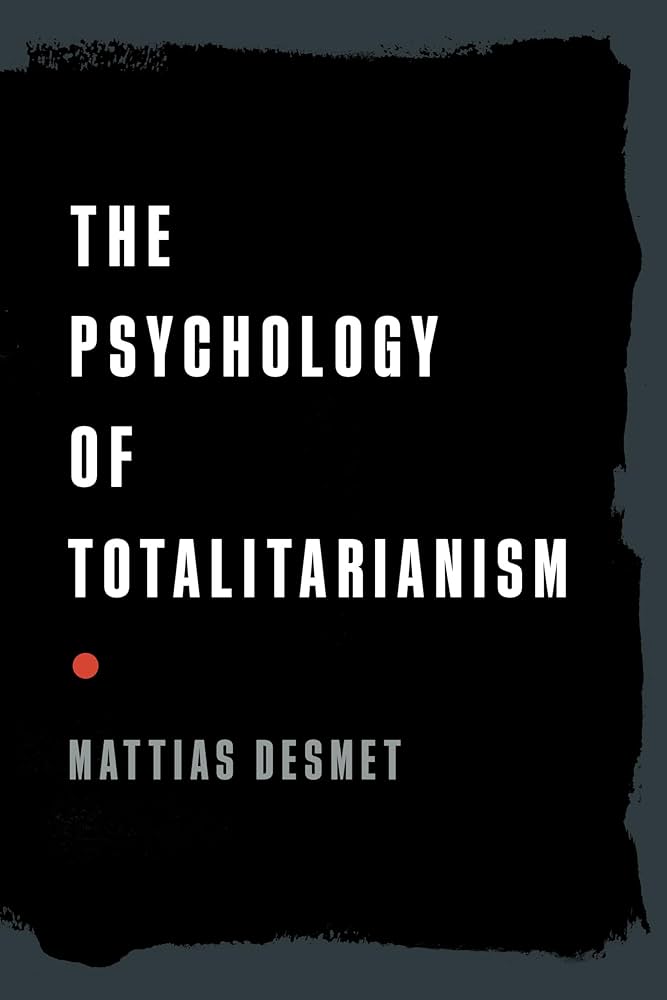
The Psychology of Totalitarianism
Mattias Desmet | Chelsea Green Publishing | 2022
Reviewed by John Zada
Mattias Desmet, professor of clinical psychology at Ghent University in Belgium, offers a more succinct theory of the social conditions and catalysts which can lead to totalitarian behavior. This includes forms of the phenomenon that don’t outwardly resemble our most obvious associations with the word.
In 1951, the German-American political theorist and philosopher Hannah Arendt published a book entitled The Origins of Totalitarianism. It is an in-depth examination and analysis of Nazism and Stalinism, drawn partly from Arendt’s personal experiences living as a Jewish person during the rise of Hitler. Her lengthy book, which explores the phenomenon of totalitarianism through a political and historical lens, became a modern classic because it is also fundamentally a work about the psychology of mass movements.
Totalitarianism, Arendt tells us, is founded upon “atomized, isolated individuals.” Such systems succeeded in gaining the cooperation of the masses in 20th-century Russia and Germany because they offered alienated people what they crave most: an ideologically consistent dogma built on grand narratives that provide a sense of meaning.
Totalitarianism differed, she says, from other forms of political dictatorship in that it employed terror against everyone—not just political opponents. “Totalitarianism has discovered a means of dominating and terrorizing human beings from within,” Arendt writes.
The mechanics of that terror, with all of its concentration camps, gulags, arrests, massacres, purges, secret police, and societal brainwashing and groupthink, are what we generally associate the most with the word “totalitarianism” today. They are its most memorable and enduring outward symbols.
Enter Mattias Desmet. In 2020, the professor of clinical psychology at Ghent University in Belgium published a book called The Psychology of Totalitarianism, which picks up where Arendt left off. Building on her work, Desmet offers a more succinct theory of the social conditions and catalysts which can lead to totalitarian behavior and systems, including forms of this phenomenon that don’t outwardly resemble our most obvious associations with the word. To drive home the point that we must revisit our definitions of this highly loaded and sometimes overused term, Desmet quotes Israeli scholar Yuval Noah Harari early in his book, who writes, “Most people wouldn’t even notice the shift toward a totalitarian regime. We associate totalitarianism mainly with labor, concentration, and extermination camps, but those are merely the final, bewildering stage of a long process.”
Totalitarianism’s Origins: Mass Formation
That long and unconscious process Desmet calls “mass formation.” He describes it as a kind of group hypnosis that destroys the ethical self-awareness of individuals and robs them of their ability to think critically. It is a form of ideological herding in which people sacrifice their own interests to enter into and maintain solidarity with a larger group cause. Those involved in mass formation gain certain psychological benefits in return for their compliance with the group: a sense of meaning where there was little or none before; reduced alienation by being caught up with a collective; and an attributable cause to the “free-flowing anxiety” affecting them which they can direct their frustration against (usually a threat that the group is obsessed with).
“The essence of mass formation,” Desmet writes, “amounts to the following: a society saturated with individualism and rationalism suddenly tilts towards the radically opposite condition, toward radically irrational collectivism.”
The free-flowing and unidentifiable anxiety in society that greases the wheels of mob appeal is a cornerstone of Desmet’s thesis. It can arise from any number of causes. It is often tied to economic or political turmoil, such as in the lead-up to the rise of the totalitarian regimes of Nazi Germany and Stalinist Russia. So too with the Jacobin Great Terror of the French Revolution in the late 1700s, the witch hunts in Europe and America in years prior, and the Crusades going back to the early Middle Ages: all examples of mass formation with totalitarian aspects. All of them involved a group united by irrational ideas that lashed out against an enemy and its sympathizers with extreme prejudice.
Desmet tells us that this societal angst in the last century has also arisen from a general ennui afflicting Western and industrial cultures. It derives chiefly from the Enlightenment’s rational and mechanistic philosophies of life that have compounded and reached a pinnacle in the current digital age. Isolation, loneliness, weak social bonds, and meaninglessness are its fruits. Here Arendt’s “atomized individuals” come to mind. These conditions make the individual vulnerable to the appeal of group belonging, which the ringleaders of what become totalitarian systems harness to their advantage.
“In all major mass formations, the main argument for joining-in is solidarity with the collective,” Desmet writes. “And those who refuse to participate are typically accused of lacking solidarity and civic responsibility. This is one reason why the absurd elements in a story do not matter to the masses: The masses believe in the story not because it’s accurate but because it creates a new social bond.”
This applies not only to the largest mass formation events, but also to smaller examples such as the January 6th US Capitol attack by radicalized supporters of Donald Trump or even, commonly, in the behavior of criminal trial juries, which can latch on to the emotional elements of a story sometimes to the exclusion of its facts.
Mass Formation and Totalitarian Governments
It is only in modern times, Desmet says, that mass formation events have morphed into full-blown totalitarian systems and governments. This is not just because modern mechanical and materialist culture creates the intensity of dissatisfaction that is its precursor, but also because 20th-century science and technology (including mass communication) could be mobilized by an ideology in pursuit of a utopian-style end. Mass formation events are more rationalized, organized and durable in the modern age as a result. They can be bolstered by science and concretized in government.
Desmet writes that totalitarianism “is ultimately the logical extension of a generalized obsession with science, the belief in an artificially created paradise… ‘an idol that will magically cure the evils of existence and transform the nature of man…it is the logical consequence of mechanistic thinking and the delusional belief in the omnipotence of human rationality.’”
And this is chiefly what makes totalitarianism different from more run-of-the-mill dictatorships and authoritarian governments. The latter are most concerned with quashing meaningful public political criticism or opposition. In many dictatorial societies, you may be free to believe what you want, go more or less about your business hassle-free, and even privately express political differences about the state. By comparison, both mass formation and totalitarianism (its late-stage blooming) involve the imposition of an actionable ideology by the masses upon itself down to the very last person. Any dissenting voices to the mass formation event, even if reasonable, are quashed because dissenters threaten to lance the hypnotic state that those in its grip seek to perpetuate. It is a larger-scale and more extreme form of groupthink that involves everyone. China’s dogmatic social engineering initiatives in pursuit of earthly paradise during the Cultural Revolution and Great Leap Forward in the 20th century, and those of Pol Pot and the Khmer Rouge in Cambodia, which resulted in many millions of deaths, were totalitarian in nature rather than simply dictatorial.
How Mass Formation Arises and the Example of the COVID-19 Pandemic
But it is totalitarianism’s hard-to-identify origins, its early mass formation events, with which Desmet says we should be most concerned. The author alleges that the Global War on Terror in the post-9/11 period and the more recent “woke” and cancel-culture movements constitute such moments. Desmet argues, too, that the group behavior exhibited during the COVID-19 pandemic constituted a significant and global mass formation event in our lifetimes: involving not just the fringe minority convinced the pandemic was both a hoax and global elitist plot, but also the larger majority supporting the strictest controls over society to fight the virus.
This may seem like hyperbole and unwarranted conflation on Desmet’s part. But the author is not criticizing public health action and precautions in and of themselves, but rather the fanatically rationalist manner in which many societies mobilized. The degree of societal bonding around a threat during the pandemic, the controls exerted upon and policed by authorities and public, the vilification of dissenters, and the pursuit of an idealized utopian condition (i.e., the attempt by humans to wrestle a global virus to the ground using technology and experiments in social organization and behavior), all meet the mass formation criteria. By highlighting such a seemingly unlikely example of mass formation, Desmet seeks to demonstrate how little we actually know about totalitarianism’s hard-to-see nascent upwellings.
Just as importantly, the social and psychological preconditions and steps to mass formation, the author says, were all there during COVID-19 as they were during the rise of Nazi Germany and Stalinist Russia:
1. A condition of atomized and alienated individuals suffering from the loneliness, meaninglessness and ennui of modern mechanized and (today) digitized life.
2. Free-floating anxiety, frustration and discontent arising from those conditions with no obvious and attributable source.
3. The emergence of a narrative from government officials and the mass media about a challenge or threat facing society.
Once those conditions were in place:
4. The free-floating anxiety of the masses attached to a threat in question (aristocracy under Stalin, Jews under Nazism, COVID-19 virus and anti-vaxxers) and resulted in a strategy to deal with that object of anxiety. Society fixated upon the story or danger.
5. This generated a sense of purpose and relief from the anxiety because society was engaged in a common struggle and was banded together in a larger cohesive social enterprise (i.e., “We are all in this together”).
6. The pent-up frustration and aggression was directed towards dissenters and those refusing to go along with the story (purges, imprisonment, execution in totalitarian states; being fired from your job, publicly shamed, and sanctioned during the pandemic for voicing disagreement to policy measures).
Once in full swing, Desmet says, mass formation brings satisfaction to the collective who do not want it to end.
“This process yields a psychological gain,” Desmet writes. “Firstly, the anxiety that previously roamed through society as a tenebrous fog is now linked to a specific cause and can be mentally controlled via the strategy put forward in the story. Secondly, through a common struggle with ‘the enemy,’ the disintegrating society regains its coherence, energy, and rudimentary meaning. For this reason, the fight against the object of anxiety then becomes a mission, laden with pathos and group heroism (for example, the Belgian government’s ‘team of 11 million’ going to war against the coronavirus). Thirdly, in this fight all latent brewing frustration and aggression is taken out, especially on the group that refuses to go along with the story and the mass formation. This brings an enormous release and satisfaction to the masses, which they will not let go of easily.”
The desire to remain in the trance is so intense that its victims are incapable of seeing the absurdity of their actions, where it manifests. Alternative voices are rejected and silenced. There is no room for discussion, dialogue or weighing of actions and alternatives. If the mass formation event, whatever it may be, continues long enough, with enough systemic indoctrination, propaganda, and silencing of dissent, then a totalitarian system may arise, such as we’ve seen a number of times in the 20th century.
Desmet points out that around 30% of any population become hardened supporters of the mass formation message and action. Another 30% reject it, with an additional 40% being unconvinced. This silent majority tend to go with the flow of the fanatical to protect their vested interests.
How to Mitigate Mass Formation and Prevent Totalitarianism
So, what can be done if a society finds itself in the throes of this unconscious group behavior? Opposing the mob, Desmet says, is a tricky affair. Arguing with the sleepwalkers does not work, as they will see it as an attack threatening the salve for their anxiety and their born-again sense of belonging. Desmet argues that a calculated and well-measured dose of subtle dissent by those who reject or are unconvinced by the ideology, especially if applied early enough, can prevent the collective trance from deepening. The key is to speak calmly and genuinely and avoid triggering anger.
If left to their own devices, mass formations and their more advanced stages of totalitarianism collapse from their own weight or fixations—or by the catastrophic situations they have created. The reckless and often unachievable goals ignore other crucial aspects of reality, causing public dissatisfaction to grow, and the trance to break. Citizens, disappointed with their leaders’ failures, ultimately turn on them. But by then the damage has been done. What matters most is to prevent the mass formation events from advancing and becoming an entrenched ideological system.
In Desmet’s view, the question of how to mitigate mass formation is a crucial one for all of humanity. For he warns of the potential for a new kind of totalitarianism in the future: a “softer” technocratic-bureaucratic totalitarianism based on surveillance and focused on maximizing social outcomes as a path to utopian organization. Given digital technology is growing in leaps and bounds (including new forms of AI since his book was published), his concern may be valid. Big tech’s “surveillance capitalism,” China’s use of a computerized social credit system to punish and reward its citizens, and the growing efforts in some Western countries to police social media and the internet for offensive opinions, may all be expressions of this. This scenario also aligns with Hannah Arendt’s dystopian vision of totalitarianism being not just a phenomenon of flamboyant thugs, like Stalin or Hitler, but also one of dull bureaucrats, technocrats and experts.
Desmet concludes by saying that societies can build resistance against mass formation events before they arise. To do so, enough people must reduce or eliminate the condition of ennui by pursuing purposeful lives, cultivating closer, in-person relationships, and embracing meaningful philosophies and outlooks on life. Only then will we be in the best position to stand firm against the attractions of joining a mob with fanatical ideas and approaches that we would otherwise reject.
John Zada is an author and journalist based in Toronto, Canada. His latest book is The Patchwork Cloak of Kamal Bey: An East-West Memoir.