
Book Review
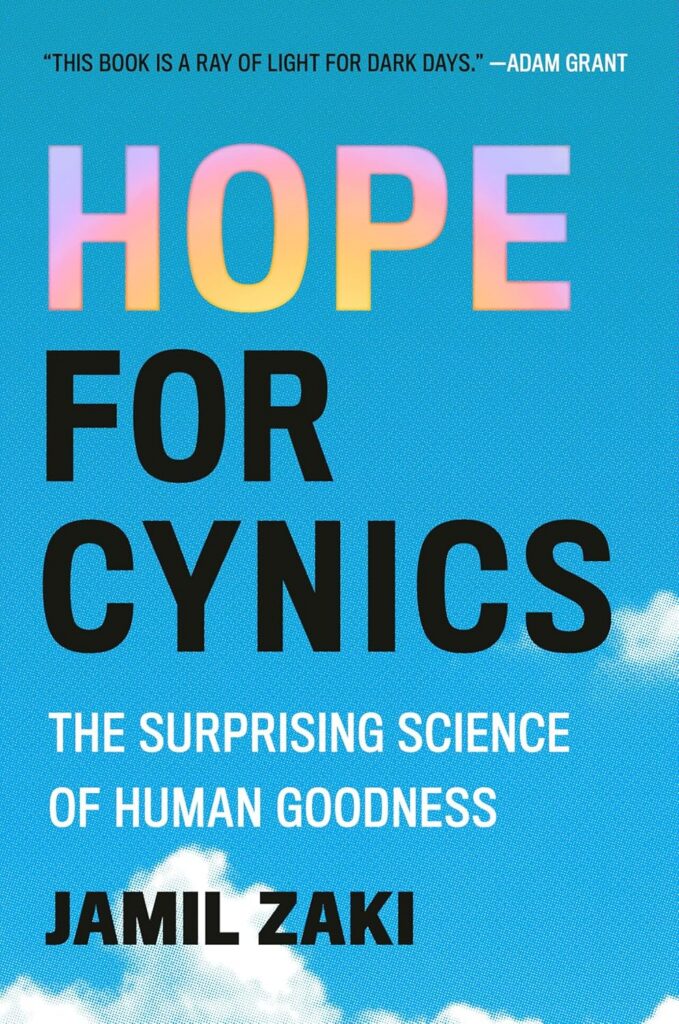
Hope for Cynics
The Surprising Science of Human Goodness
Jamil Zaki / Hachette / 2024
Review by Mel Raff
Cynicism is an understandable response to a world full of injustice. But in many cases, it is misplaced. Dozens of studies find that people fail to realize how kind, generous, and open-minded others really are. Cynical thinking deepens social problems: when we expect the worst in people, we often bring it out of them.
A cynic, psychologist Jamil Zaki tells us, believes people are greedy and untrustworthy and behave without concern for others. In Hope for Cynics, he urges skepticism instead, something quite distinct from cynicism and from its opposite, blind faith. He argues that skepticism is more closely tied to reality than either of these. He defines skepticism—in contrast to naively trusting one’s beliefs, be they optimistic or pessimistic—as testing one’s beliefs against new information and then adjusting them accordingly.
His central point is that cynicism, like ingenuous trust, is unwarranted by actual experience. Economists’ experiments designed to measure trust show most non-cynics estimate that trust will be returned by the hoped-for behavior only about 50% of the time. In reality, the rate is actually 80%. So evidence places the cynical point of view overwhelmingly at odds with reality and shows that even most non-cynics are significantly more pessimistic than the data warrants.
The evidence is not confined to economic experiments. In all but 2 of 27 Gallup polls between 1989 and 2020, a majority of respondents thought crime had increased, but from 1990 to 2020, crime actually decreased—by almost 50 percent! We’re safer than ever but don’t realize it.
As these data show, “negativity bias” —paying more attention to bad news than good—is inescapable. It is widely cultivated by the media and inflamed by what journalist Amanda Ripley terms “conflict entrepreneurs” (those who deliberately manufacture or amplify conflict for their benefit), as well as by social media, which encourage conflict entrepreneur behavior in all of us. “Cynics are not born, they’re made, and our society is minting them,” Zaki tells us.
Cynicism, he says, is a societal disease that breaks down social trust, not only distorting reality but affecting every aspect of our lives, increasing polarization, isolation and loneliness. No wonder, then, that studies show cynicism increases depression and physical health problems, lowers earnings, and shortens lives. As treatment for this disease, Zaki proposes a combination of skepticism and hope.
Yet on the very first page of this book, he confesses a secret: privately, Zaki was himself a cynic, prone to believing most people selfish and untrustworthy. This condition made him envy his distinguished colleague Emile Bruneau, founder of the Peace and Conflict Neuroscience lab at the University of Pennsylvania. Despite (or because of) a difficult childhood and family life, Bruneau embodied the very opposite of Zaki’s secret cynicism and proved the inspiration for this book, which maps out a path from cynicism to hope.
We all place somewhere on the spectrum of cynicism, the actual placement varying from moment to moment and year to year. But hopeful skepticism, meaning testing our assumptions, whether pessimistic or optimistic, will better tether our behavior to reality. This, in turn, will strengthen our connections with others and increase our hope that things can improve—and, as Zaki shows, it will further reveal practical means to assure that they do improve.
He cites enormous societal forces, including economic inequality and the erosion of individual trust and freedom, that drive us toward cynicism and “pre-disappointment,” the self-fulfilling expectation that society itself has betrayed us and that social trust is foolish and naive. Today’s media amplifies these forces, acting as “a cynicism machine.” We could add to these the “empathy shortfall” Robert Ornstein and Paul Ehrlich cite as a product of our small group evolution in Humanity on a Tightrope. The unfortunate result is a cultural glamorization of cynicism, undergirded by three essential myths:
- Cynicism is clever.
The idea that cynics are more intelligent than those who are trusting—what Zaki terms the myth of the cynical genius—is disproven by the data. Furthermore, cynics turn out to be less adept than more hopeful people in problem-solving, math, even in identifying liars! This makes sense, given Ornstein and Ehrlich’s assertion in their earlier work, New World, New Mind, that many of us substitute “naive cynicism” for judgement. - Cynicism is safe.
Every act of trust is a gamble, so if you don’t trust anyone, you can’t lose. But such safety, Zaki says, is “. . . only safe in the way that house arrest is.” - Cynicism is moral.
This idea—that so much is wrong with the world that hope and optimism are simply naive evasions of truth—represents a cynical attitude toward hope and provides false justification for doing nothing but maintaining the status quo.
These myths and the forces that propagate them inflict on us a “collective cynicism” with dire consequences. We know that cooperation is what has enabled our species to reach its unprecedented level of global success: when people cooperate, everyone does better. But without trust, people stop cooperating, and things quickly deteriorate: health, prosperity, and democracy all depend on trust; without it, they all collapse.
Telling symptoms of our collective cynicism include loneliness and isolation, which then further increase our cynicism. What Zaki calls “social shark attacks” —imaginary painful social interactions (actual shark attacks being 50 times less likely than a lightning strike)—lead us to expect others to disappoint us, so we don’t take the chance on social interaction.
This fear that interactions will be painful dominates our imagination and leads us to ignore the predominance of positive interactions, furthering polarization and isolation. Watching our interactions more closely will help us correct this misperception, Zaki says, reminding us that true self-care is being involved with others: “There is no tidy separation between self and other. Our species is intertwined, such that helping others is a kindness to ourselves, and watching over ourselves supports others.”
Clearly, much is wrong with the world, but Zaki has discovered that hope and trust are skills we can develop to improve our situation. Just as we are influenced toward cynicism, we can be influenced in the other direction, toward hopeful skepticism. Such influence depends on a key distinction between optimism, the idealistic belief that things will get better, and hope, the practical belief that things could get better. We underestimate our influence, both positive and negative: while our own cynicism can breed more in others, our own trust can increase others’ trustworthy behavior—and their trust in others, too.
So how do we make such a shift? How do we move our individual and collective actions and beliefs away from cynicism toward a social wisdom based on healthy, hopeful skepticism?
Zaki says the foundation is to make trust our default, to take the leap of faith of believing in others, which will then encourage others to believe in themselves and will bring out their best—a self-fulfilling counterstrike against cynicism.
Such a foundation flows naturally from the recognition that Social Darwinism, based on the principle of “survival of the fittest,” is an incorrect reading of evolution. As detailed here in The Origins of Morality, humans are born with a moral sense that implies kindness, fairness, justice, and empathy; even plants exhibit a certain morality and cooperation. Zaki understands that evolutionary survival and success have always depended on cooperation: “Animals thrive by working together, not against one another. Hyper-social creatures, like human beings, take this to another level. Communities form their own cultures and compete against one another like clashing superorganisms. The more intense the struggle between groups, the more individuals must team up to come out on top.” As Robert and Sally Ornstein tell us in God 4.0, the success of our species has been built on our ability to bond together in families and communities—but now, “Instead of identifying with tribes or families, we need to bring up our children to identify with humanity itself.”
In the 1980s, political scientist Robert Axelrod was puzzled by the conundrum of how evolution could proceed through cooperation when creatures must compete for scarce resources just to survive. So he experimented with a simulation of evolution, a computerized tournament based on the famous “prisoner’s dilemma” game, testing a variety of competing strategies of cooperation vs. striving for individual gain, to see which was most effective. Over time, the superior strategy was trust—not simple blind trust, but “generous trust,” a willingness to ignore small transgressions over the course of a long term. This strategy generated positive behavior in others and was consistently proven the most successful approach. Zaki affirms this, telling us that trust is “a form of power, one that builds connections, creates new opportunities, and changes people for the better.”
Despite the prevalence of the Social Darwinist point of view, people do typically view their own acquaintances positively, so Zaki advises us to generalize from that, rather than engage in “tribal cynicism” —the belief that our social circle is an exception to the behavior of people in general.
In the 1800s, economist John Neville Keynes coined the term homo economicus to ironically describe the behavior of the mythical person that economists studied, focused only on self-interest and personal gain. We do not behave this way, but assuming we do enables neat economic analyses and predictions—which continue to this day—and encourages behavior that centers on competition and maximizing profit over all other values. These behaviors create cynical organizations and suspicious managers, where individual performance is valued over cooperation and workers are constantly monitored to assure their productivity. The result is a zero-sum environment where people seek personal advantage over coworkers rather than organizational success. But as a counter to such behavior, Zaki quotes former NBA star and US senator Bill Bradley: “the success of the group assures the success of the individual, but not the other way around.” The antidote to homo economicus, Zaki tells us, is homo collaboratus, replacing the Social Darwinist leadership and punishment culture with anti-cynical leadership based on trust and shared credit.
Another key to moving from cynicism to healthy skepticism is recognizing the distinction between beliefs and values, something Zaki thinks we often overlook. “Beliefs are assumptions or conclusions; values are the parts of life that bring a person meaning. Beliefs reflect what you think of the world; values reveal more about yourself.” So values are fundamental to the individual, while beliefs can be tested against reality and adjusted accordingly.
Zaki’s inspiring colleague, Emile Bruneau, was a great believer in self-reliance and found Emerson’s essay of that name a huge inspiration. Zaki at first had difficulty squaring knowledge of that fact with the socially oriented person he knew so well. But eventually he came to realize that “people who affirm their values become more open to information that contradicts their beliefs. It takes confidence in yourself to question your opinions.” That confidence, that security in asserting one’s values, breeds trust and enables skepticism—of one’s own cynicism.
Such skepticism can help us resist negativity bias and the resulting pre-disappointment—the expectation that everyone will let us down. This allows us to correct the misunderstandings that Zaki finds at the heart of much of our conflict, mistrust, and polarization. In 2022, to test the idea that we are more in agreement than generally assumed, he devised an experiment enlisting 100 Americans in 20-minute Zoom calls with a rival, discussing issues such as gun control, climate change, and abortion. The most common rating of the discussions afterwards was 100% positive, and “participants’ dislike of rivals plummeted by more than 20 points on a hundred-point scale and remained lower three months later.” From that research, he distilled these four tips for “disagreeing better”:
1. Ask questions instead of making statements.
2. Work to get underneath people’s opinions to their stories.
3. Name common ground when recognized.
4. When uncertain, say so rather than pretending to be confident.
But if skepticism and attacking misunderstanding seem hopeful, is such hope realistic? Or is it just a way of ignoring problems and pretending all will work out for the best? Zaki says this cynical attitude toward hope dissolves on close examination of the data; as we’ve seen, he argues that hope is itself a strategy for social change. The truth is that many people feel the same anger at the injustices and failures of our society, and realizing that enhances our connections with others as well as our own power. Believing that others will act makes one’s own action more likely.
He endorses Martin Luther King’s “creative maladjustment,” which shares cynicism’s awareness of injustice but adds the realization that things can improve, and therefore looks for ways to work toward that improvement. We should struggle toward justice, Zaki argues, not because the goal is within reach but because this struggle is the right thing to do—and also because it is empowering. Efficacy is the sense that we can do something, but “Efficacy without anger can leave us complacent. Anger without efficacy leaves us paralyzed and cynical. Neither inspires much action. But together, they form an emotional alloy of social change, which looks a lot like creative maladjustment.” As Emile Bruneau said, “the best way to activate a communal force is to be a community. That’s why we’re here.”
Mel Raff has a BA and PhD in literature from the University of Maryland, and an MA in creative writing from the Johns Hopkins University. He is a longtime contributor and member of The Human Journey project.