Technology and Education
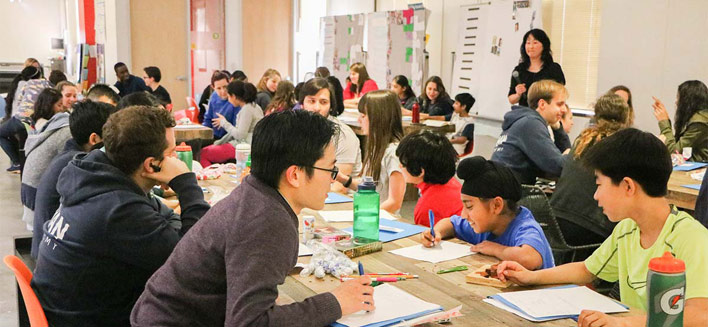
Technology plays an increasingly integral role in shaping learning environments and pedagogical approaches in education today. With the advent of digital tools and resources, many classrooms are evolving into dynamic spaces where students engage with interactive learning platforms, multimedia content, and collaborative projects. Teachers harness technology to personalize instruction, cater to diverse learning styles, and foster critical thinking skills. From interactive whiteboards to educational apps and online resources, technology has the potential to enhance accessibility and expand the horizons of traditional education. However, challenges such as the digital divide and ensuring responsible technology use underscore the need for thoughtful integration of technology in today’s schools.
There is nothing new under the sun, and the belief that heavy use of communication technology is harmful to our brain and its functions is no exception. About 400 BC, Socrates expressed succinctly this concern: “[…] this discovery of yours will create forgetfulness in the learners’ souls because they will not use their memories; they will trust to the external written characters and not remember of themselves. The specific which you have discovered is an aid not to memory but to reminiscence.” (Plato, orig. date unknown/1986) Of course, Socrates wasn’t referring to iPads, laptops, or the Class-Whizz. Socrates was talking about written language.
“The Dilemma of Digital Technologies” from Hard Questions on Global Education Change, Pasi Sahlberg and Associates
Robert Moses, founder of the Algebra Project, recognized the potential of technology to facilitate learning years ago, using graphing calculators with his students. Moses believed that all students, regardless of background, are capable of learning advanced math as long as they can add and the teacher can get their attention. “My students, like many of their generation, do not read as much as they should. Most of what they learn they learn from pushing buttons and seeing how images change. Their modalities of learning have been attuned to this image-making process. If you use these graphing calculators, you arouse their interest. The kids will take time to try to figure out how the calculator works…Students do not open a math book and say, ‘Let me show you what I know on this page,’ but they will show you what they know about a single button on a graphing calculator. Therefore, I think you have got to go where the kids are. And that place is different from the place where teachers have been taught to be.”
Most children today are native users of digital technology. More and more schools provide each student with their own classroom laptop or tablet and have one or more technology experts on staff. When the COVID-19 pandemic forced school closures and created an urgent need for remote learning options, Evan Marwal, founder of the non-profit organization EducationSuperHighway, pivoted from focusing on increasing internet access in schools (which had grown due in part to the organization’s efforts) to increasing students’ at-home access to high-speed internet.
“Blended learning,” the combination of digital with face-to-face content and activity, is becoming more common. One model is the “flipped classroom” popularized by the Khan Academy and others. This approach moves the delivery of material outside the formal class time, so that students arrive familiar with the topic and use the classroom time to extend their knowledge through discussion and interactive activities. While some research has found positive effects associated with flipped classrooms, the effects have been highly variable. Others have questioned the popularity of the model given the mixed findings, and have suggested that the value of “flipping” depends on largely on the details of how that model is implemented. As researchers Kapur, Hattie, Grossman and Sinha write:
…the effects of flipped must consider the nature of the implementation and not generalize to “flipping” as if there was a singular interpretation of the activities in flipped and control classes. Many of the activities deemed critical to flipping also occur regularly in the traditional classroom, and the major effect of flipping seems to be increasing exposure to passive learning and the time on task. The largest impact of active learning is when it precedes in-class instruction or is undertaken as part of traditional instruction, contrary to the core claim of flipped instruction.
Education scholar Yong Zhao distinguishes “personalized” learning from truly “personalizable” education, arguing that the latter “gives back to students the agency of learning; makes them co-owners of the education institution; is flexible so as to accommodate changes and individual needs; and has a strong culture that celebrates value creation so students can learn to use their passions, strengths, and efforts to serve the world beyond themselves.” Technology in education has the potential to realize that model.

The Other Segregation
Whitney Pirtle, The Atlantic
The public focuses its attention on divides between schools, while tracking has created separate and unequal education systems within single schools.
Math with Meaning
COMP & SIAM
Math educators provide helpful guidelines for transforming traditional math equations and problems in a way that gives students as early as pre-K the foundation to tackle open-ended, reality-based questions collaboratively—questions that they find meaningful and can enhance their future. (PDF)

▶ Video
Our Failing Schools: Enough Is Enough
Geoffrey Canada, TED
Why does our education system look the way it did 50 years ago? Millions of students were failing then, as they are now—and it’s because we’re clinging to a business model that clearly doesn’t work. Education advocate Geoffrey Canada dares the system to make systematic shifts in order to help greater numbers of kids excel.

▶ Video
Do Schools Kill Creativity?
Sir Ken Robinson, TED
Here the entertaining and profoundly moving case for creating an education system that nurtures (rather than undermines) creativity.
EducationSuperHighway. “About Us.” Accessed January 18, 2024.
Kapur, Manu, John Hattie, Irina Grossman, and Tanmay Sinha. “Fail, Flip, Fix, and Feed – Rethinking Flipped Learning: A Review of Meta-Analyses and a Subsequent Meta-Analysis.” Frontiers in Education 7 (September 26, 2022). https://doi.org/10.3389/feduc.2022.956416
Khan Academy. “Khan Academy.” Accessed January 18, 2024.
Sahlberg, Pasi, Jonathan Hasak, and Vanessa Rodriguez. Hard Questions on Global Educational Change: Policies, Practices, and the Future of Education. Teachers College Press, 2017.
Sanford, Stefanie. “How the Pandemic Gave EducationSuperHighway a New Lane: Interview with Evan Marwell.” College Board Elective, February 17, 2021.
Strelan, Peter, Amanda Osborn, and Edward Palmer. “The Flipped Classroom: A Meta-Analysis of Effects on Student Performance across Disciplines and Education Levels.” Educational Research Review 30 (June 2020): 100314. https://doi.org/10.1016/j.edurev.2020.100314
The Algebra Project. “The Algebra Project.” Accessed January 6, 2024.