
Mind and Health
Chest pain, back pain, dizziness, headache, difficulty breathing, inability to sleep, abdominal pain and lack of energy. Sound familiar? These are the most common reasons people consult a physician.
But despite how common these ailments are, less than half of all people displaying these symptoms are appropriately diagnosed by their doctors—even after a thorough patient history, physical exam and medical testing. Doctors either don’t diagnose or do so inaccurately because they’ve failed to consider a very common root cause of human suffering and the source of many physical symptoms—namely, psychological stress.
Stress Matters
While some patients—about 10 to 20 percent—exhibit extreme anxiety and depression indicative of a major psychiatric disorder, most people have what is best termed “everyday psychological distress.” This more common type of psychological distress has a major impact on daily physical and social functions. It even produces disabilities equivalent to diabetes, hypertension or arthritis.
The majority of Americans report unhealthy stress levels. And one in five people quantify their stress level as “extremely high.” What’s perhaps even more worrisome is that only 37 percent of Americans feel they’re able to adequately manage their stress. Most commonly, stress originates from work, financial pressures, family responsibilities, relationships and personal health concerns.
Ironically, stress negatively impacts the aspects of people’s lives that cause it in the first place. For instance, 70 percent of individuals who are stressed experience physical symptoms, lower productivity at work, and disruptions in their family and social lives.
Furthermore, adults with high stress levels are less likely to eat healthily, engage in physical activity, get enough sleep or moderate their alcohol consumption. These behaviors—often caused by stress—lead to additional health problems like depression, cardiovascular disease and even a greater susceptibility to colds. Stress can even affect our genes and speed up the aging process. Women with high stress levels experience a shortening in portions of their DNA with results equivalent to nearly a decade of accelerated aging compared to women with less stress.
We know stress-related symptoms take a toll on individual health. But studies also show the dire impact stress has on our nation’s work productivity and overall health care system. A third of US workers report feeling extremely stressed at work. And this job-related stress is costing American industry an estimated $300 billion a year in absenteeism, turnover, diminished productivity and on-the-job accidents. Meanwhile, health care expenditures are nearly 50 percent greater for workers who report high levels of stress.
Early childhood stress seems to exert an exceptionally powerful influence throughout life. A long-term study of 17,000 people found that adverse childhood experiences are very common:
- 11% experienced emotional abuse
- 28% experienced physical abuse
- 21% experienced sexual abuse
- 15% experienced emotional neglect
- 10% experienced physical neglect
- 13% witnessed their mothers being treated violently
- 27% grew up with someone in the household using alcohol and/or drugs
- 19% grew up with a mentally ill person in the household
- 23% lost a parent due to separation or divorce
- 5% grew up with a household member in jail or prison
The study also found that these children have profound, lasting, and damaging effects throughout life. The more categories of trauma experienced in childhood, the greater the likelihood of experiencing:
- alcoholism and alcohol abuse
- chronic obstructive pulmonary disease (COPD)
- ischemic heart disease (IHD)
- liver disease
- smoking
- obesity
- depression
- suicide attempts
- poor health-related quality of life
- illicit drug use
- risk for intimate partner violence
- multiple sexual partners
- sexually transmitted diseases (STDs)
- unintended pregnancies
- fetal death
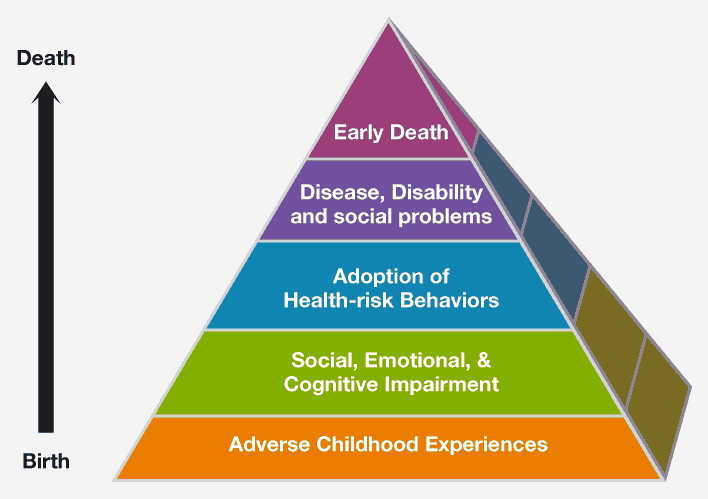
The total lifetime economic burden resulting from new cases of fatal and nonfatal child maltreatment in the United States is approximately $124 billion in 2010 dollars. This economic burden rivals the cost of other high profile public health problems, such as stroke and type 2 diabetes.
Fortunately, there is evidence that some of this child maltreatment and its health, social and economic consequences can be prevented.
The Other Side of Stress: Why Positive Moods and Mindset Matters
Some stress can actually be positive, particularly when it motivates necessary lifestyle changes and builds resilience. Interestingly, the effect of stress on health and well-being seems to be moderated by your view or “mindset” regarding the impact of stress. People who view stress as potentially helpful, something to be used and embraced (“stress-is-enhancing” mindset), fare much better than those who see stress as something that makes you sick and to be avoided and reduced (“stress-is-debilitating” mindset). The good news is that these stress mindsets can be altered. In one experiment, when “stress-is-enhancing” videos were shown to people, their symptoms of anxiety and depression, as well as work performance improved.
In a study of over 28,000 people those who reported both a lot of stress and the perception that stress affects their health had a 43-percent increased risk of death. In fact, believing that stress is harmful to health may have caused over 20,000 premature deaths per year, making this the 15th leading cause of death in America. Seeing the upside of stress is not about deciding whether stress is either all good or all bad. It’s about how choosing to see the good in stress can help you meet the challenges in your life.
Studies show that positive and negative moods influence physical health and longevity independently. Mounting evidence demonstrates that happiness, pleasure, joy, optimism, excitement and sense of humor each have positive biological and physiological effects. So, while counteracting chronic stress and reducing negativity is important, another key to better health is finding happiness.
People who report that they are very happy (with less negative and more positive emotion and optimism) live four to ten years longer than unhappy individuals. More so, those extra years are also lived healthier. Further, people who express positive emotions like joy, cheerfulness, and enthusiasm are 22 percent less likely to develop heart disease than those who don’t. In fact, in a study of nearly 100,000 women, optimists were 30 percent less likely to die from coronary heart disease than pessimists. Happiness, even expressed in a given day, is a statistical predictor of health. In one study, those who reported a more positive mood in one 24-hour period experienced a 50 percent lower death rate over the next five years compared to those who were less happy that day.
The fact that happiness—and its many forms—can improve one’s health raises an important question: Can we choose to be happy? If we’re generally unhappy, can we reset this emotion or are some people too influenced by genetics, upbringing, and environment to modify their emotional state?
Of course, separating cause and effect is difficult here. Does one’s negativity cause stress that causes negative health outcomes? Likewise, can day-to-day happiness alone reverse negative health trends? Evaluating the impact of stress levels on lifestyle change is complex.
Factors like genetics and the environment can impact both disease prevalence and mood. But regardless of etiology, when faced with such adversity, happy people optimize their health and cope better than those who are unhappy.
Happily, there is mounting evidence that our moods and happiness can be modified by some simple activities and interventions that reshape our thoughts and moods each day.

UK Appoints a Minister for Loneliness
Ceylan Yeginsu, New York Times
Since Britain voted to leave the European Union more than a year ago, Europeans have mockingly said that the decision will result in an isolated, lonely island nation. But Britain, in fact, already has a serious problem with loneliness, research has found, affecting more than nine million people, prompting Prime Minister Theresa May to appoint a minister for loneliness.

Change Your Mindset, Change the Game
Alia Crum
Stanford professor, athlete and psychologist Alia Crum investigates the role of mindsets in affecting health behaviors and outcomes.

▶ Video
How to Make Stress Your Friend
Kelly McGonigal, TED
Stanford professor, athlete and psychologist Alia Crum investigates the role of mindsets in affecting health behaviors and outcomes.

▶ Video
The Game That Can Give You 10 Extra Years of Life
Jane McGonigal, TED
In this moving talk, McGonigal explains how a game can boost resilience — and promises to add 7.5 minutes to your life.
American Psychological Association. Stress in America™: Missing the Health Care Connection. February 7, 2013. Accessed November 29, 2024. https://www.apa.org/news/press/releases/stress/2012/full-report.pdf
Crum, Alia J., Peter Salovey, and Shawn Achor. “Rethinking Stress: The Role of Mindsets in Determining the Stress Response.” Journal of Personality and Social Psychology 104, no. 4 (April 2013): 716–33. https://doi.org/10.1037/a0031201
Davidson, K. W., E. Mostofsky, and W. Whang. “Don’t Worry, Be Happy: Positive Affect and Reduced 10-Year Incident Coronary Heart Disease: The Canadian Nova Scotia Health Survey.” European Heart Journal 31, no. 9 (February 17, 2010): 1065–70. https://doi.org/10.1093/eurheartj/ehp603
Epel, E. S., Blackburn, E. H., Lin, J., Dhabhar, F. S., Adler, N. E., Morrow, J. D., & Cawthon, R. M. (2004). “Accelerated telomere shortening in response to life stress.” Proceedings of the National Academy of Sciences of the United States of America, 101(49), 17312–17315. https://doi.org/10.1073/pnas.0407162101
Felitti, Vincent J., Robert F. Anda, Dale Nordenberg, David F. Williamson, Alison M. Spitz, Valerie Edwards, Mary P. Koss, and James S. Marks. “Relationship of Childhood Abuse and Household Dysfunction to Many of the Leading Causes of Death in Adults.” American Journal of Preventive Medicine 14, no. 4 (May 1998): 245–58. https://doi.org/10.1016/s0749-3797(98)00017-8
Keller, Abiola, Kristin Litzelman, Lauren E. Wisk, Torsheika Maddox, Erika Rose Cheng, Paul D. Creswell, and Whitney P. Witt. “Does the Perception That Stress Affects Health Matter? The Association with Health and Mortality.” Health Psychology 31, no. 5 (2012): 677–84. https://doi.org/10.1037/a0026743
Kroenke, Kurt, and A. David Mangelsdorff. “Common Symptoms in Ambulatory Care: Incidence, Evaluation, Therapy, and Outcome.” The American Journal of Medicine 86, no. 3 (March 1989): 262–66. https://doi.org/10.1016/0002-9343(89)90293-3
McGonigal, Kelly. The Upside of Stress: Why Stress Is Good for You, and How to Get Good at It. Penguin Publishing Group, 2016.
National Institute for Occupational Safety and Health. “Stress at Work – Publication No. 99-101.” U.S. Department of Health and Human Services, Public Health Service, Centers for Disease Control and Prevention. January 1, 1999. https://doi.org/10.26616/nioshpub99101
Sobel, David S. “Rethinking Medicine.” Psychosomatic Medicine 57, no. 3 (1995): 234–44. https://doi.org/10.1097/00006842-199505000-00005
Steptoe, Andrew, and Jane Wardle. “Positive Affect Measured Using Ecological Momentary Assessment and Survival in Older Men and Women.” Proceedings of the National Academy of Sciences 108, no. 45 (October 31, 2011): 18244–48. https://doi.org/10.1073/pnas.1110892108
The American Institute of Stress. “Workplace Stress.” Accessed November 29, 2024.
Tindle, Hilary A., Yue-Fang Chang, Lewis H. Kuller, JoAnn E. Manson, Jennifer G. Robinson, Milagros C. Rosal, Greg J. Siegle, and Karen A. Matthews. “Optimism, Cynical Hostility, and Incident Coronary Heart Disease and Mortality in the Women’s Health Initiative.” Circulation 120, no. 8 (August 25, 2009): 656–62. https://doi.org/10.1161/circulationaha.108.827642