
Book Review
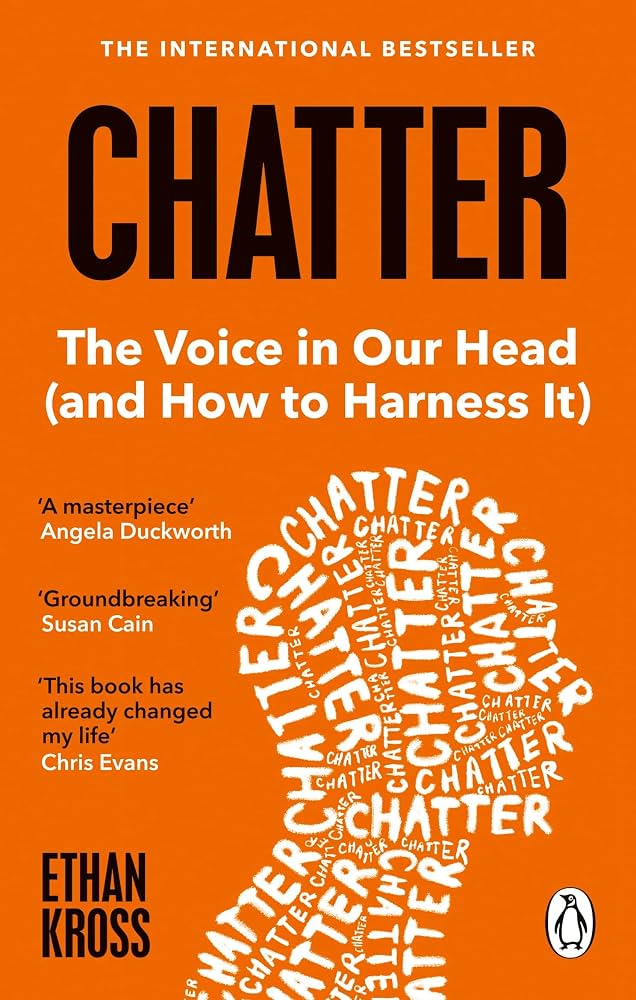
Chatter
The Voice in Our Head (And How to Harness It)
Ethan Kross | Crown-Penguin Random House | 2021
Reviewed by Sally Mallam
Psychology professor Ethan Kross tells us that silent mental dialogues are intrinsic to human nature. We can arrive at sound judgments for making decisions by avoiding unproductive mental chatter, while taking advantage of the best of our ‘inner voice’ to reflect on life’s circumstances.
Have you ever replayed a conversation in your head, thinking of things you could have said, or should have said? Or lain awake at night worrying about what you need to get done tomorrow, imagining everything that might go wrong? That running commentary in your mind, sometimes helpful, sometimes exhausting, is described by psychologists as your inner voice.
Every day our brain is busy talking to us. We’ve all noticed that and how often it happens, even at times when we’d rather be focusing on a specific task. But do we realize how much chattering is going on inside our heads? According to psychology professor Ethan Kross, we self-talk at the equivalent rate of speaking 4000 words per minute out loud, or the equivalent of 320 US Presidential State of the Union addresses each day!
In Chatter: The Voice in Our Head and How to Harness It, Kross explains why this tendency is so fundamental as to be called our default state. Reminding us that its continuous existence must confer a survival advantage, he asks and answers why and how it evolved.
We’re not born with this ability. It begins very early in life and develops as a child’s language skills develop; and, of course, it goes hand in hand with a child’s emotional development and social environment. A child from a family with rich communication patterns will tend to develop this capacity earlier than one where language is less fluent.
At its core, this inner voice is simply our ability to talk to ourselves silently. It is thanks to the activation of this network that we reflect, plan, imagine, and make sense of our lives and the world around us. We are a storytelling animal. We use this network to create our own story, linking our experiences in ways that make sense to us and keep us safe. Through what psychologists call “autobiographical reasoning,” we construct a coherent life story, the continuity of which helps us navigate change and adversity, clarify our values and desires, and create meaning while grounded in a stable sense of identity.
And we share stories, our experiences and our memories, constantly with others. By paying attention to our own thoughts and feelings, we can remember, reflect, problem solve and create a sense of ourselves through time. Without this default mode network none of this would be possible, as Kross says, we wouldn’t be able to rehearse a job interview in our heads, learn from mistakes, or even decide what to do next.
The brain is a very talented multitasker, using the same systems for multiple purposes. Were it not so, Kross points out, “it would need to be the size of a bus.” The process is what neuroscientists call “neural reuse.” In this case, the mechanisms involved in language and working memory, particularly the “phonological loop,” which involves our inner ear and our inner voice, allow us to rehearse information, plan actions, and regulate behavior. Without this system, even simple daily tasks would become difficult to manage. The neuroanatomist Jill Bolte Taylor describes how this would be. She experienced a massive hemorrhage in the left hemisphere of her brain, leaving her without inner self-talk: she was totally free from “chatter.” But she was no longer able to imagine a future or remember her past. “Without verbal introspection,” Kross notes, “she ceased to be human in the previous sense she had known.” In her book My Stroke of Insight, she wrote that “Devoid of language and linear processing, I felt disconnected from the life I had lived.”
She lost her identity. Kross describes how “those little voices inside your head,” as Bolte Taylor put it, made her her, but now they were silent. So she asked herself, “Was I really still me? How could I still be Dr. Jill Bolte Taylor, when I no longer share her life experiences, thoughts and emotional attachments? … The growing void in my traumatized brain were entirely seductive. I welcomed the reprieve that the silence brought from the constant chatter.” Kross explains that “Being robbed of language and memory, on the one hand, was terrifying and lonely. On the other hand, it was ecstatically, emphatically liberating. Free from her past identity, she could also be free from all the recurring painful recollections, present stresses and looming anxieties.”
As Kross points out, the opposite can also happen. When self-talk is excessive and repeatedly negative, it can undermine mental and physical well-being. Instead of facilitating reflection, the chattering inner voice can trap individuals in cycles of rumination, focusing narrowly and constantly on distressing thoughts. This consumes our cognitive resources, particularly those associated with executive functions such as attention and reasoning. As a result, our performance suffers in tasks ranging from academic tests to professional decision-making. In this state, our stress responses are intensified, triggering prolonged activation of stress hormones like cortisol. Over time, this can contribute to serious health problems, including cardiovascular disease and weakened immune function.
Unchecked inner dialogue—or “chatter”—tends to distort experience. It takes hold of our attention, releasing a surge of strong negative emotion that can sabotage our performance on tests or on stage, even in business negotiations. Most poignantly, Kross describes the fate of the Cardinal pitcher Rick Ankiel, who in 2000 showed signs of becoming one of the best pitchers in the major leagues. After an amazing season, he threw wild—and his inner “monster” took hold. Despite years of practice and training in which he perfected his throw into a seamless whole that he could execute without thinking, throwing wild set him back to break the movements down and focus on the details, which only exacerbated the situation. His inner conversation grew so loud and “vicious” that it grabbed his attention and took over: anxiety, panic and fear took hold, and in 2005, at the young age of 25, he stepped away from pitching completely.
Research shows that what we think about tends to have a greater impact on our happiness than what we are actually doing. A person may be in a positive situation yet feel miserable due to intrusive negative thoughts. Socially, chatter can lead to maladaptive behaviors such as aggression or withdrawal, and it can be exacerbated by modern environments like social media, which encourage constant sharing without the moderating effects of time or face-to-face meetings, which encourage empathy and understanding.
It took Jill Bolte Taylor over eight years to regain her inner voice. She reflected that she hadn’t learned to manage her buzzing inner world prior to her stroke. Like all of us, she had trouble controlling her emotions when she got sucked into negative spirals.
At the end of this book, Kross gives us a number of very useful, straightforward and simple “tools” to manage our inner world when it is challenged. Among these are:
Distraction
A dominant approach to battling inner voice rumination is distraction. But the author suggests that it’s a short-term fix: once we’re back from the temporary escape, the inner voice is still there with all the problems associated with it.
Distancing
A powerful tool that enables us to remain engaged but with less emotional agitation. There are a number of ways to approach this:
- Stepping back from one’s thoughts and viewing them from a broader perspective. We might visualize events from the standpoint of a detached observer, zooming out and looking at it all from a distance.
- Mental time travel—asking oneself if the concern will matter in a month or a year from now.
- Comparing our own experiences with those of others. Imagine what you would say to a friend in the same situation.
- Distanced self-talk—Try talking to yourself like another person: “Why did Sally say that?” or “Why did Sally get so angry?” By referring to oneself in the third person rather than the first, we can rapidly reduce emotional intensity and get back to a more rational frame of mind.
Kross and his colleagues designed an experiment to measure how quickly this strategy works. Showing participants very disturbing photographs, they monitored the electrical activity of their brains using an electroencephalogram, and found that, when using the third person rather than the first, within one second of viewing the same image, changes in emotional activation took place and participants felt relief.
Their work also demonstrated that distanced self-talk can stimulate our ability to interpret sources of stress as challenges rather than threats. Tell yourself that what you’re feeling—rapid heartbeat, nervous tension etc.— is there to prepare you for challenge, not to sabotage you. Tell yourself, “You can do this!!”
Engaging with supportive individuals
Study after study shows that venting about our negative experiences does not help us recover “in any meaningful way.” As examples, Kross includes those who shared their thoughts and feelings about 9/11 right after it happened: “… on the whole, they fared worse than the people in the study who didn’t open up about how they felt.” Similarly, when they looked at students who survived two tragic mass shootings, at DeKalb’s Northern Illinois University in 2008 and at Virginia Tech the year before, they found that while expressing their emotions initially made the students feel better, “the degree to which they shared their emotions didn’t actually influence their depression and post-traumatic stress symptoms.” So, although one does need support, selecting someone who can help reframe the problem, giving a different perspective, is very important.
Spending time in nature
Kross reminds us that hospital patients with rooms looking out on nature—even a small cluster of trees—have been shown to recover faster, take fewer pain killers, and were judged more resilient than those whose rooms looked out onto a brick wall. Similarly, people who lived in apartments with views over green space were “significantly better at focusing their attention than those whose buildings looked out onto barren cityscapes.” They procrastinated less and their behavior and thinking were more positive because they were better able to focus their attention. “Trees and grass seemed to act like mental vitamins that fueled their ability to manage the stressors they faced.” We’ve already talked about the experience of awe and its ability to lift us out of our self-centered default mode. A walk in the woods, or by the ocean, are among those experiences that trigger this feeling in us all. The good news is that the brain does not differentiate between photos or videos of natural scenes. Should we not have access to nature, videos and photos will do; as Kross tell us, “Virtual nature is, incredibly, still nature as far as the human mind is concerned.”
Engaging in rituals
Engaging in rituals, personalized or collective, mitigates chatter, because they direct our attention away from the self-centered “ME-priority” that is the main concern of the default mode. Since rituals involve restrictive and repetitive steps, they invoke a sense of order that calms us; our minds move away from preoccupations to connect to a larger purpose. Rituals even work when made up by participants themselves in times of stress. In his book Ritual: How Seemingly Senseless Acts Make Life Worth Living, Dimitris Xygalatas gives many examples that show how carrying out rituals gives us peace of mind and a sense of control. A ritual can be an act as large as the Hindu Kumbh Mela, which involves hundreds of millions of participants, or as small as organizing one’s own surroundings, and as individual as the one performed by the tennis ace Rafael Nadal, who lined up his water bottles just so before every match.
At the end of Chatter, the author reminds us that “The human mind is one of evolution’s greatest creations, not just because it allowed our species to survive and thrive, but because in spite of the inevitable pain that comes with life, it also endowed us with a voice in our head capable of not only celebrating the best times, but also making meaning out of the worst times. It’s this voice, not the din of chatter, that we should all listen to.”
Research also reveals that the default mode plays a central role in facilitating our mind’s higher cognitive processes. A deeper understanding of its organization and function and the conditions under which these may be stimulated are discussed elsewhere on this site. Thinking clearly and constructively is, of course, a vital first step—and Kross’s book provides a way forward.
Sally Mallam is the executive director of both The Institute for the Study of Human Knowledge (ISHK) and The Human Journey project.