
Book Review
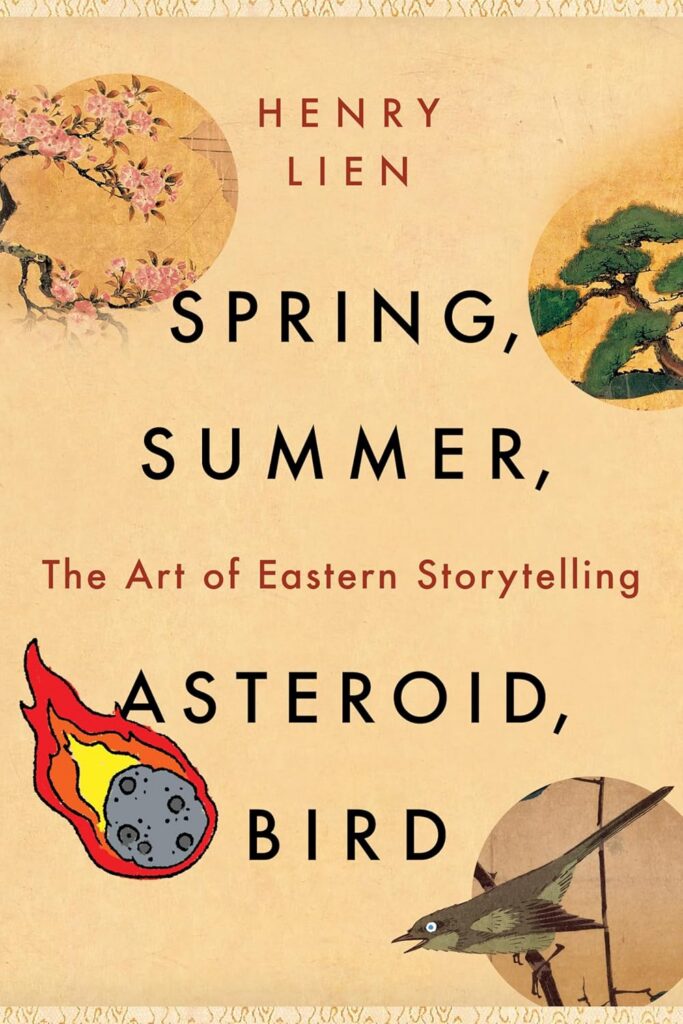
Spring, Summer, Asteroid, Bird
The Art of Eastern Storytelling
Henry Lien / WW Norton / 2025
Review by Sally Mallam
What are the different ways of telling a satisfying story, and how do different cultures go about doing so? Henry Lien differentiates and clarifies the contrasting elements of storytelling in the East and West, allowing us to reflect on the values and approaches of each tradition.
Since the beginning of the 21st century, Western storytelling has increasingly emphasized diversity. But this emphasis has mainly focused on the identities of characters, creators, and performers. In his book Spring, Summer, Asteroid, Bird, the speculative fiction writer Henry Lien shows that diversity in storytelling involves much more than representation.
Through examples from films, literature, and video games, he shows that meaningful diversity emerges when storytelling traditions from different cultures influence the form of a narrative, not just the people who appear in it. As he says: “true diversity in the arts should encompass diverse story forms and themes, in addition to diverse faces.”
One striking example he gives is from a 1966 article, “Shakespeare in the Bush,” by the American anthropologist Laura Bohannan. She recounts a remarkable and almost comical cultural collision. Confident that human nature, and therefore stories, were universal, Bohannan attempted to tell the story of Shakespeare’s Hamlet to a group of Tiv elders in southeastern Nigeria. She carefully translated the tale using Tiv words and cultural comparisons, certain the meaning would carry across cultures.
Instead, confusion erupted.
At every turn, the Tiv listeners reshaped the story according to their own traditions and beliefs. To them, there was nothing strange about Hamlet’s uncle marrying his mother after the king’s death; in their society, such a marriage was perfectly normal and expected. The supposed moral outrage at the heart of the tragedy simply vanished.
The deeper Bohannan went into the tale, the more the story unraveled. When she described the ghost that appears to Hamlet, the Tiv elders firmly rejected her explanation. They did not believe it could be the spirit of Hamlet’s dead father; after all, in their worldview, the dead do not return in that way. The apparition, they insisted, must be an omen sent by a witch.
Bohannan tried to correct them, insisting that the figure truly was Hamlet’s father returned from the dead. The elders then nodded in understanding and explained that in their language, a person who returns from the dead is called a zombie. Bohannan protested that there were no zombies in Shakespeare’s play—but by that point, the story was slipping out of her control.
Forced again and again to adjust the narrative to fit the Tiv interpretation, Bohannan watched Shakespeare’s tragedy slowly transform into something unrecognizable. By the time the tale staggered to its conclusion, it bore almost no resemblance to Hamlet at all and revealed just how deeply culture shapes the way we understand stories.
Hamlet may not be universal, but many of the works that the author identifies as stories with Eastern narrative structures are popular worldwide, including with Western audiences.
Lien selects the musical Hamilton as an example of the difference between surface diversity and deeper narrative diversity. The musical features a racially diverse cast, yet the historical story focuses largely on white figures from early American history, including Alexander Hamilton. While the casting represents surface-level diversity, the production demonstrates a deeper form of diversity through its storytelling style—how the story is told. By combining historical narrative with modern musical traditions such as hip-hop and rap, soul and traditional Broadway musicals, it blends different cultural influences and shows that diversity can exist in form and artistic expression, not just in casting.
To describe how storytelling traditions differ, Lien looks at the basic structure of stories. First, the three-act structure (sometimes expanded into the five-act dramatic model known as Gustav Freytag’s pyramid). This structure dominates Western narratives, appearing in many popular works, including Star Wars: Episode IV – A New Hope, which he uses as an example.
In this structure:
- Act 1 – Setup: the story introduces characters, setting, and a central problem.
- Act 2 – Confrontation: tension grows as obstacles and conflicts intensify.
- Act 3 – Resolution: the conflict reaches a climax and is resolved.
Freytag’s model describes this progression as a symmetrical dramatic arc consisting of exposition, rising action, climax, falling action, and resolution. Today’s Western audiences expect narrative elements introduced early to return later and be resolved. The confines demanded by today’s media may well influence the prevalence of this arc, such that when it fails to happen, a story may feel incomplete and unsatisfying. Lien reminds readers that Western adherence to this structure wasn’t always the case. Introducing a sudden solution at the end of a story was prevalent in ancient Greek drama, for example, from which the plot device known as deus ex machina, meaning “god from the machine,” originates. Actors playing gods appear suddenly, perhaps via crane or trapdoor, and swoop on to the stage to solve insurmountable problems and conclude the drama.
Lien brings our attention to the fact that stories reflect and affect cultural assumptions and values. Western stories often focus on an individual hero who overcomes obstacles. In contrast, many East Asian storytelling traditions follow a different narrative model known as Kishōtenketsu, used in Japan, China, Korea, and Taiwan. This four-act structure includes:
- Act 1 – Ki – introduction of the main elements.
- Act 2 – Shō – development of those elements.
- Act 3 – Ten – a surprising twist or new element.
- Act 4 – Ketsu – harmonization of all elements.
Here the story does not rely primarily on conflict between opposing forces. Instead, it focuses on exploring relationships between narrative elements. The third act introduces an unexpected development that reframes earlier events, and the final act connects all the elements together. The ending may be abrupt or ambiguous, leaving the audience to reflect on the meanings of the story.
Lien notes that Western audiences are already familiar with this style without realizing it. Many games produced by Nintendo—including franchises such as Super Mario Bros. and The Legend of Zelda—use variations of this four-act structure. The South Korean film Parasite is a perfect example, according to Lien, where “All the differing interpretations and conflicting responses to the ending are typical features of act four of the four-act structure. It elucidates the hitherto invisible strings connecting all the elements in the prior acts and then ends abruptly, often without clear or easy resolution, so that the story continues to echo in our heads long after the movie ends.”
The author next examines circular and nested narrative forms. “Circular stories” revisit events, places, or themes multiple times, revealing new meanings with each return. “Nested stories,” or stories told within other stories, create layers of narrative that gradually build a broader understanding of events. A classic example of nested storytelling is One Thousand and One Nights.
These non-linear storytelling structures are particularly effective for exploring philosophical themes such as fate and free will. A modern example is the 2022 film Everything Everywhere All at Once, whose complex, layered narrative reflects its themes about family relationships and the overwhelming complexity of life.
Lien further addresses the pivotal connection between stories and their cultures. The tension, conflict resolution and symmetry that are staples of Western storytelling, provide a pattern that our species seeks. “We learn from stories where others of our species meet obstacles and overcome them. They map a sense of order onto a bewildering and dangerous world and serve to pass on ancestral survival tips.”
Unsurprisingly then, Western societies tend to emphasize individualism, and frequently focus on self-discovery, personal empowerment, and heroic individuals overcoming adversity. Research by psychologist Joseph Henrich suggests that Western societies, sometimes described as WEIRD (Western, Educated, Industrialized, Rich, and Democratic), are often mistakenly treated as representing universal human behavior.
Many East Asian traditions, by contrast, emphasize collectivism and the relationship between individuals and their communities. Stories shaped by these values tend to highlight:
- the individual’s role within family and society
- collective achievement rather than individual heroism
- internal reflection rather than external conflict
- understanding one’s place within a larger system
Through the legend of Hua Mulan, Lien emphasized the difference between the surface diversity he noted first in Hamilton and deeper cultural understanding. In this traditional Chinese story, Mulan fights in order to honor and protect her family, emphasizing duty and responsibility. Unlike most Western heroines, strength and femininity coexist in her character, and her actions highlight loyalty and social harmony. The Disney animated adaptation of Mulan reshaped the story into a familiar Western narrative about personal independence and rebellion against expectations. Although it features Asian characters and settings, the structure and themes remain distinctly Western, making it an example of surface diversity rather than a true engagement with the story’s cultural origins.
A story can do the reverse: reflect another culture’s values without representing that culture directly. Lien points to the novel Never Let Me Go by the Japanese novelist Kazuo Ishiguro. Although set in England with mostly white characters, the story expresses themes associated with East Asian philosophy: acceptance of fate, emotional restraint, and the search for meaning through relationships rather than rebellion. Many Western readers disliked the characters’ acceptance of their circumstances, but Lien argues that the story offers a different kind of hope: finding dignity, meaning and connection even in an imperfect world.
In the four-act structure, a surprising development does not defeat an enemy but instead reveals hidden relationships between events, emphasizing observation and contemplation rather than dramatic conflict. Stories such as Miyazaki’s animated film, My Neighbor Totoro, which follows Kishōtenketsu, reflects a worldview that values patience and attentiveness. Lien notes that the Western version would have had to “include some life lessons about growing up or learning about the world.” But the world of Totoro is the safe world of childhood. It demonstrates how wonder and emotional insight can be central to a narrative without relying on intense conflict.
Circular and nested narratives extend this idea by showing that truth often emerges from multiple perspectives rather than a single linear storyline. The Chinese martial arts epic film Hero is a circular story thatpresents several conflicting versions of the same events, reminding many readers of Kurosawa’s groundbreaking psychological drama Rashomon that revolutionized cinematic storytelling in 1950. The contradictions in Hero encourage viewers to question each narrator’s reliability and to examine the moral dilemmas faced by the characters. In this way, the film’s structure reflects its themes about power, unity, and cultural difference.
Lien also highlights the importance of empathy in storytelling achieved through nonlinear structures, such as nesting. In the frame narrativeof One Thousand and One Nights, Scheherazade tells stories night after night to delay her execution by a king who has become cruel after being betrayed by his wife. Through her stories, she gradually helps him confront his pain and rediscover his humanity. The nested layered structure of the narrative allows their relationship to develop slowly, demonstrating how storytelling structures can foster understanding and emotional healing.
The author notes that the idea of cyclical time plays an important role in many Chinese cultural traditions. Repetition is not seen as redundant but as an opportunity to discover new insights. This contrasts with Western traditions influenced by legalistic thinking, where clarity and precision in written rules are emphasized. In those traditions, repetition can seem unnecessary, while, as Robert Ornstein noted in “The Teaching Story – A Unique Literary Form,” in other cultures it is a way of gradually uncovering deeper truths. Each retelling can add meaning and deepen understanding.
Across these examples, Lien’s central argument is clear: story structures grow from cultural values, producing different story shapes that reflect different ideas about the world. In general:
- Western structures grow from individualism and conflict.
- East Asian four-act structures reflect balance, humility, and harmony.
- Circular and nested narratives highlight connections across time, communities, and histories.
True diversity in storytelling means much more than representing different people on screen or on the page. It requires embracing different narrative forms, philosophies, and ways of understanding the world.
Lien’s ability to differentiate and clarify key elements of storytelling in the East and West deepens our awareness of the differences and allows us to reflect on the values and approaches of each tradition. At the end of the book he includes exercises to ensure that readers and writers build a more stable and comprehensive understanding of these elements in the stories we are exposed to and create.
Sally Mallam is the executive director of both The Institute for the Study of Human Knowledge (ISHK) and The Human Journey project.