
Book Review
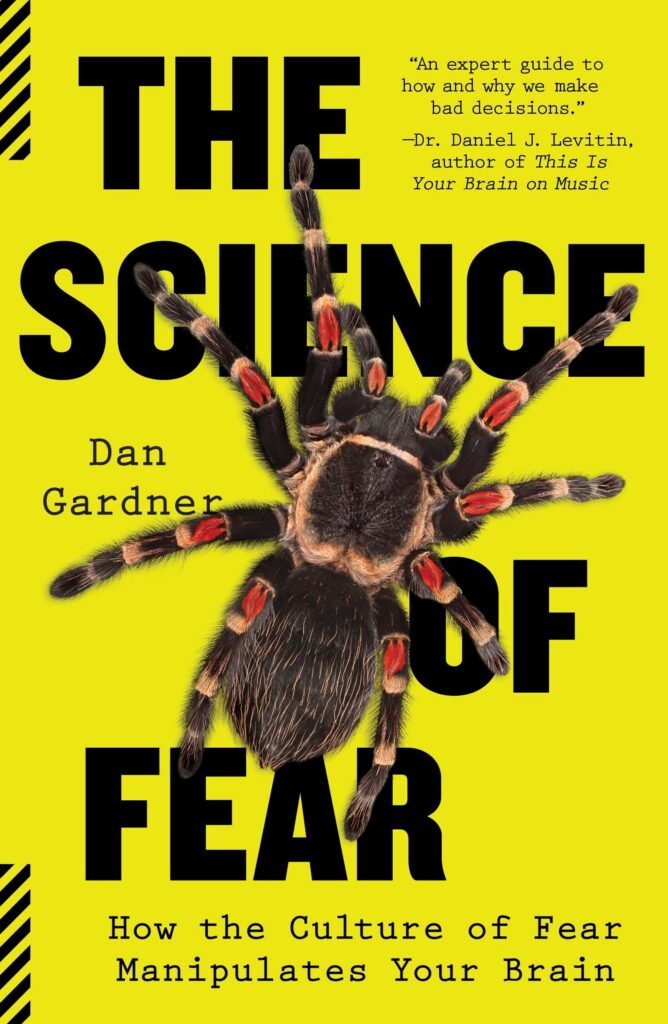
The Science of Fear
How the Culture of Fear Manipulates Your Brain
Dan Gardner | Penguin Random House | 2009
Reviewed by: Denise Winn
We humans are endlessly preoccupied with fears, anxieties and concerns of every kind: from the biggest picture threats that imperil countries, economies and civilizations to our own personal apprehensions. Yet we are the safest and healthiest humans in history. Why are we so worried?
Award-winning journalist Dan Gardner demonstrates how irrational fear springs from the ways humans miscalculate risks based on our hunter-gatherer brains—and how we can rise above them.
Mass death and destruction can come in countless ways. Poison introduced into water supplies, planes crashing into nuclear reactors, lethal viruses let loose in the underground system, carcinogens in places never before suspected. Did you feel just a flicker of anxiety, a momentary faster beating of the heart? That is at the crux of this splendid, meticulously researched book—the emotional arousal unnecessarily generated by unlikely events, increasing widespread fear and mistrust.
Yet, as science writer Dan Gardner points out, we contemplate common death traps with surprising equanimity. Driving on a motorway is more likely to end in death than sitting in a plane or being killed by a handgun. And the death toll caused by diabetes, heart disease and other common illnesses is far, far higher than that caused by terrorist attacks ever.
Fear is a fantastic marketing tool, used by companies, politicians, activists, charities and whomever else it benefits to manipulate our emotions. It is Gardner’s aim to explain, in a vividly written page-turner, just why we are so susceptible, exploring a slew of powerful psychological concepts, including confirmation bias, group polarization, peer pressure, the affect heuristic (more colloquially, if it feels good it can’t be so bad), and so forth.
It is worth pointing out that some of the neuroscience has moved on in the 17 years since the publication of The Science of Fear. Gardner still talks of the emotional brain, and the power struggle between Gut and Head, as if our brains contain two largely independent systems, whereas this idea has now been thoroughly debunked by neuroscientist Lisa Feldman Barrett and others. Our reactions are governed by whatever serves—or once served—our survival needs best, in the cultures we live in (the predictive brain). But Gut and Head can still be useful metaphors for the emotional arousal that often overwhelms more rational perspectives.
There is certainly no question that our psychology leaves us open to manipulation of all kinds. A factor that influences our beliefs about “common” threats to our wellbeing is what Gardner dubs “the example rule.” In a telling experiment, students were asked how many words fitting the form “– – – – – n –” they would expect to find in four pages of a novel. When asked the same question for words fitting the form “– – – – ing,” they predicted at least three times as many. This is seemingly counter-intuitive because more words should fit the first form than the second, as it is less prescriptive—but the latter provides us with a more familiar frame, so the more common we deem it to be.
This has real-life consequences. When people with no family history of heart disease were asked to list three behaviors they engaged in that could raise their risk of it, they rated their risk higher than if they were asked to list eight factors. Why should this be? Because, according to the experimenters, people struggled to come up with eight.
Fear is a highly effective way of gluing a memory in place, of course. We see particularly vivid footage of some disaster, or we have a brush with death ourselves, and our fight-or-flight response is automatically activated, and the pattern stored. It is the vividness that is relevant here. Indeed, the harder something is to imagine, the less affected we are likely to be. When students were asked to read symptoms of a new disease, which included low energy, headaches and muscle aches, they were much more likely to think they could get it than those asked to imagine a vague sense of disorientation, malfunctioning nervous system and inflamed liver.
Fascinatingly, this finding extends even to fictionalized versions of risk. Researchers carried out cross-country surveys in the US after the release of a highly dramatic film depicting unrealistic impacts of global warming across America, such as widespread floods, food shortages and a new Ice Age. Those who had seen the movie consistently deemed such outcomes more likely. And whether or not familiarity breeds contempt, it certainly breeds gullibility: the more we hear something, even fake news we know is fake, the more inclined we become to believe it.
Gardner explores in some depth the influencing effect of how we tell a story. For instance, we relate far more personally to a statement that 20 out of 100 people will suffer such and such, rather than 20 per cent, which feels remote and distant. As he points out, “Every journalist knows that people respond very differently to numbers and stories.” An event that took many lives does not grab the attention in the way that a bus that overturned on a particular pass, killing 35, will do. He offers a fascinating argument that storytelling, particularly personal stories that we can easily imagine, must have an evolutionary advantage, citing biological anthropologist Robin Dunbar’s observation that storytelling is the human version of forming and maintaining social bonds, achieved by chimpanzees, in their smaller societies, through grooming each other. It can also, Gardner adds, be a valuable form of rehearsal for challenges we may face, an incomplete guide to what is true (although this, of course, can be misused). Conversely, innate human skill with numbers is apparently not far superior to that of rats or dolphins and can lead to naïve beliefs: told that the arsenic levels in their drinking water is three parts per billion, most people can’t make sense of that information—but they do know that “arsenic is a Bad Thing: press the panic button.”
This, for me, explains why so many of us are prepared to say we are poor at math, whereas we would be ashamed of sharing that we struggle with reading—a difference that appalls most mathematicians but maybe makes evolutionary sense. When the late British journalist John Diamond was given the low survival statistics for the cancer that eventually killed him, he demurred, saying the statistics were 50:50—“I recover or I don’t.” And don’t we all think the coin will flip to heads if tails have been coming up for a while? Yet every flip of the coin is forever random. So our identification with stories and our poor mathematical grasp can both be used effectively to ramp up fear.
There is so much more. You might think, as did I, that you know what confirmation bias is all about—paying attention only to information that supports our existing view, which, of course, skews reality enormously. We can surely deal with that if we make a special point of looking at all sides of an argument. However, Gardner demonstrates it in far more subtle ways. Suppose you were given a sequence of numbers—2, 4 and 6—and told you can test if you have figured out the rule. You might ask, “Does 8, 10 and 12 follow the rule?” Yes. “14, 16 and 18?” Yes. “What about 20, 22 and 24?” Yes. Clearly, then, the rule is even numbers increasing by 2. And the answer is no. The correct answer is “Any three numbers in ascending order.” If we had tried asking if 5, 7 and 9 followed the rule, we might have been halfway there. But we tend not to see beyond what we are already thinking.
While only a small matter with sequences of numbers, Gardner goes on to observe that, when like-minded people form groups to discuss risks from hazardous waste or insecticides or nano particles, existing shared views tend to become more extreme, rather than being questioned—the tendency known as group polarization. And then, of course, the story gets into the media and raises fear to a whole other level. Every journalist knows that it is more powerful to tell the moving story of an affected individual than to stick with the statistical norm. Whenever, as a medical journalist, I was asked to write about breast cancer, I was urged to interview someone young rather than someone over 70: the heartstring pull is stronger (and the pictures more appealing). Indeed, American research showed that, out of 172 articles studied, not one profiled a woman in her 70s, despite two-thirds of breast cancer diagnoses occurring after 60. However, if we cynically think that journalists are milking our emotions, it is worth remembering that what grabs readers’ attention is exactly what grabs them, too.
The marketing of fear is literally big business. “Corporate marketers are very imaginative,” observes Gardner. He recounts how Purell, a hand-sanitizer marketed by Pfizer, was sold with the slogan “Imagine a touchable world” and on its website listed 99 places where germs were likely to lurk, such as subway seats and poles, keypads, shopping cart handles and so forth: “Pfizer portrays virtually any object touched by humans as a potential threat and any contact with any such object as a crisis that calls for a squirt of Purell. Welcome to the world of Howard Hughes.”
Charities, NGOs, activist groups all market fear, if they think it is for good ends. But often they are mistaken. It isn’t toxins per se that are dangerous but the amounts of them in drinking water, the air, food and so on. It is also very hard to make weapons of mass destruction. And that is what gets lost in the well-meaning outrage.
There are other facets to this, too, as Gardner explains: “The fact that a politician may have something to gain by promoting a threat does not mean he or she does not believe the threat is real. … People like to see themselves as basically good and so admitting that they are promoting fear in others in order to advance their interests sets up a nasty form of cognitive dissonance. … Self-interest and sincere belief seldom part company,” he drily observes.
So, as he concludes, the reason that we are so very scared in one of the safest times in human history all boils down to two overarching facts: we are fallible humans in an age when manipulation has never been easier. If publishing now, Gardner would have had a field day with AI.
References
Barrett, Lisa Feldman (2020). Seven and a half lessons about the brain. Lesson no 1.
Houghton Mifflin Harcourt Publishing, New York.
Barrett, Lisa Feldman (2017). How Emotions are made: the secret life of the brain. Page 251.
Houghton Mifflin Harcourt Publishing, New York.
Denise Winn is a writer, journalist and psychotherapist. She is author of The Manipulated Mind: Brainwashing, Conditioning and Indoctrination, and is a human givens practitioner.
Barrett, Lisa Feldman. How Emotions Are Made: The Secret Life of the Brain. Houghton Mifflin Harcourt Publishing, 2017, p.251.
Barrett, Lisa Feldman. Seven and a Half Lessons About the Brain, (Lesson no 1). Houghton Mifflin Harcourt Publishing, 2020.