Out of Africa
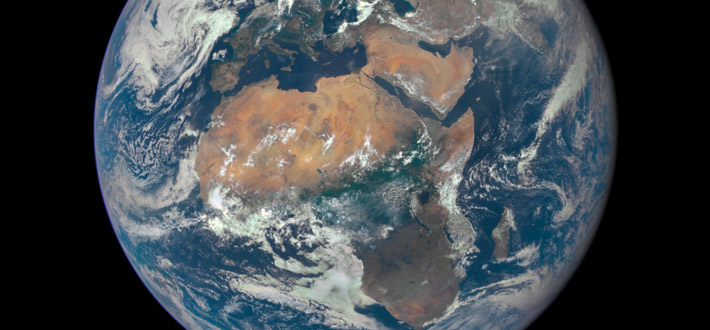
In 1967, a team led by Richard Leakey found two hominid skulls and some bones near the Omo River in Ethiopia. And 38 years later, dating techniques established that they were 195,000 years old. More recent dating of fossils found at Jebel Irhoud in Morocco suggest that Homo sapiens, or anatomically modern man, evolved in networks across Africa beginning 300,000 years ago.
![Human migration patterns. [National Geographic]](https://humanjourney.us/wp-content/uploads/human-migration-routes-nat-geo-1.png)
In 2016 studies were published by three separate teams of geneticists who collected and examined DNA from 787 people from hundreds of indigenous populations around the globe. They revealed that all non-Africans today trace their ancestry to a single population.
Our species tried multiple times to leave Africa as climatic changes made it necessary and possible. A jawbone recently found in a cave in Israel dates from between 177,000 and 194,000 years ago. People in Papua New Guinea carry a trace of DNA from an earlier wave of Africans who left the continent as long as 140,000 years ago, and then disappeared. One group of H. sapiens, discovered in Israel, left Africa across the area we now know as the Sahara Desert at a time when it was fertile. They died out when drought returned to the region, leaving skeletal remains that are between 120,000 and 90,000 years old. Sophisticated tools that date back as far as 100,000 years ago have been found in Saudi Arabia and India; and Chinese scientists have found teeth belonging to H. sapiens that appear to be as old as 120,000 years.
Current studies of climate change and fossil data indicate that from about 125,000 years ago Homo sapiens traveled out of Africa at least four times and reached China and Europe simultaneously around 90,000 to 80,000 years ago. These migrations occurred from 106,000 to 94,000 years ago, 89,000 to 73,000 years ago, 59,000 to 47,000 years ago, and 45,000 to 29,000 years ago.
According to University of Hawaii at Mano climate scientist Axel Timmermann, the era around 60,000 to 70,000 years ago—generally thought to be the main timeframe for modern human dispersal out of Africa—was one of the most extended drought periods in northern Africa, Saudi Arabia, and the eastern Mediterranean in the last 125,000 years, “Walking into the Arabian Peninsula around 60,000 to 70,000 years ago,” he remarks, “would have been a bad choice.”
At whatever precise period they left, our successful human journey out of Africa was possible thanks to falling sea levels when, researchers estimate, we managed to cross into Arabia via the Bab-el-Mandeb Strait on the Red Sea. Scientists estimate that lower sea levels due to the onset of the ice age would have meant that the gap between the continents was only about eight miles, which they somehow managed to cross.
The Fiction of Race
There is no evidence to support the biological notions of race. None. There’s no such thing as an African race or a white race. Skin color is extremely variable on the African continent and is still evolving. A study of diverse African groups led by University of Pennsylvania geneticists shows that “most of the genetic variants associated with light and dark pigmentation appear to have originated more than 300,000 years ago in Africa, and some emerged roughly one million years ago, well before the emergence of modern humans. The older version of these variants in many cases was the one associated with lighter skin, suggesting that perhaps the ancestral state of humans was moderately pigmented rather than darkly pigmented skin.”
Recall that the chimpanzee is our nearest extant animal relative and 98.7% genetically identical to us. “If you were to shave a chimp, it has light pigmentation,” says Sarah Tishkoff, the senior author of the study, “so it makes sense that skin color in the ancestors of modern humans could have been relatively light.” Tishkoff noted that this work underscores the diversity of African populations and the lack of support for biological notions of race.
Losing body hair enabled us to sweat and so cool down more easily. It is likely that when we moved from forests to the open savannah and lost the hair covering our bodies, we needed darker skin to protect us from the sun’s ultraviolet radiation. So we produced more melanin—a term used to describe a large group of related molecules responsible for many biological functions, including pigmentation of skin and hair and photoprotection of skin and eye.
People living in northern latitudes often don’t get enough UV to synthesize vitamin D in their skin so natural selection has favored two genetic solutions to that problem—evolving pale skin that absorbs UV more efficiently and favoring lactose tolerance to be able to digest the sugars and vitamin D naturally found in milk. The earliest evidence of milk consumption so far found is in the tartar of the dental remains of a 6,000-year-old Neolithic farmer in Britain.
The Search for a Better Life
It seems that from the very start, human beings have moved on in search of better living conditions: food, space and relative safety. As new births swelled their numbers, a group would divide and so prevent the discord that emerges in large foraging populations. One group would remain and the other would move on to unclaimed territory. Geneticists’ maps show that we travelled from Arabia to India to Japan and Australia.
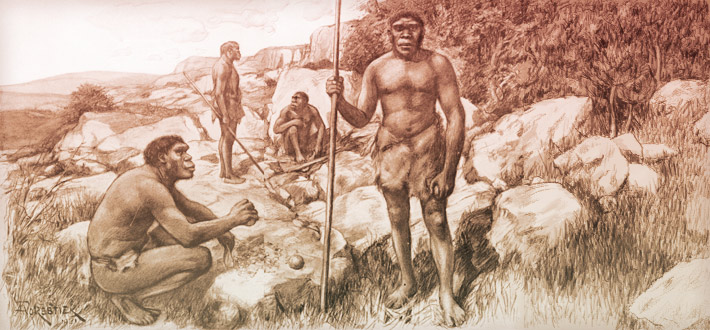
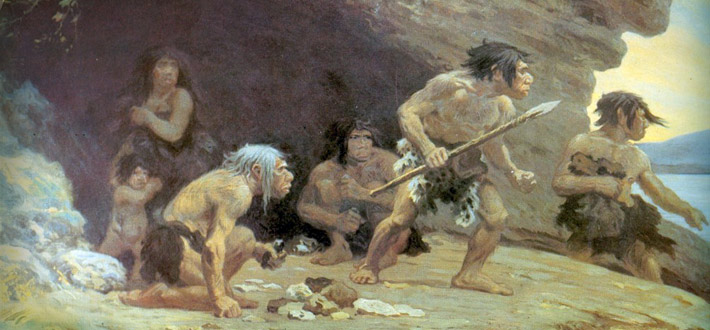
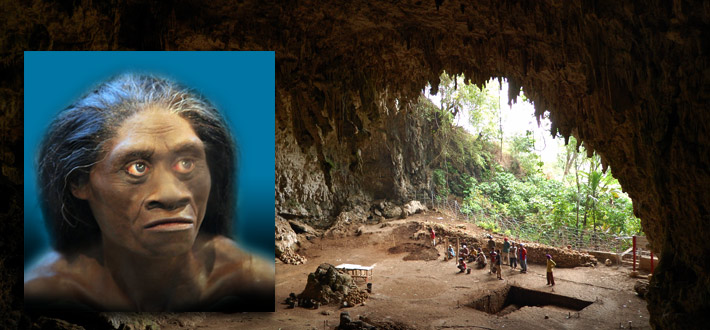
40,000 years ago we were sharing the planet with Neanderthals, Denisovans, Homo floresiensis and possibly the last remnants of Homo erectus. These groups did not coexist in isolation—Homo sapiens interbred with Neanderthals and Denisovans, and new evidence suggests that two other “ghost” ancestors further complicate our family tree. Researchers from UC Berkeley and Johns Hopkins have published evidence showing sequences of DNA in the human genome that do no match up with any of the ancient species previously sequenced. These sequences may have come from Homo erectus, plus another ancient hominin who mated with Homo sapiens before the African migration.
Genetic differences that distinguish modern humans from Neanderthals are the same as those that distinguish other animals from each other, such as dogs from wolves. Known as the neural crest, this cluster of cells causes physical differences, like our comparatively smaller brain, and affects the adrenal glands which play a key role in fear and stress. This suggests that as humans recognized the benefits of collaborative behavior, population densities increased, and, as they did so, it became beneficial for us to favor individuals with greater abilities to form and contribute to groups.
As the psychologist Thomas Suddendorf points out in his book The Gap, it’s only because all the other hominids went extinct—along with, until quite recently, all evidence of their existence—that we began to think of ourselves as vastly different and superior from other primates.
Thanks to DNA studies, we know that the common ancestor of all non-Africans interbred with Neanderthals at least four times and that the Melanesian peoples also interbred with Denisovans. The complete story continues to unfold: genomes of present-day Aboriginal Australians, for example, are thought to perhaps include traces of an ancient liaison with an unknown hominid group.
“What you can see from the DNA of all non Africans is that they all originate from one small band of Africans that came across the Red Sea. … If it was easy to get out of Africa we would have seen multiple African lineages in the DNA of non-Africans but that there was only one successful exit suggests it must have been very tough to get out. It was much drier and colder then,” said Dr. Stephen Oppenheimer, a geneticist at the school of anthropology at Oxford University, in 2009. Later research has shown that there were earlier migrations out of Africa, although most did not contribute significantly to the ancestry of people living outside Africa today.
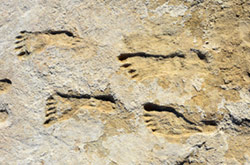
Human Footprints Near Ice Age Lake Suggest Surprisingly Early Arrival in the Americas
Lizzy Wade, Science
If dates hold, tracks would put people in New Mexico thousands of years earlier than thought.
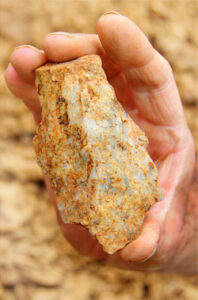
Archaeologists in China Discover the Oldest Stone Tools Outside Africa
Carl Zimmer, New York Times
Chipped rocks found in western China indicate that human ancestors ventured from Africa earlier than previously believed.
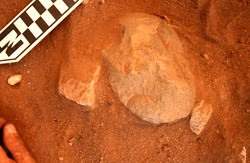
Indigenous Rock Shelter in Top End Pushes Australia’s Human History Back to 65,000 Years Ago
Genelle Weule and Felicity James, ABC News
New excavations of a rock shelter near Kakadu National Park indicate humans reached Australia up to 18,000 years earlier than archaeologists previously thought.
Unprecedented Study of Aboriginal Australians Points to One Shared Out of Africa Migration for Modern Humans
Tom Kirk, Phys.org
Outside Africa, Australia has one of the longest histories of continuous human occupation, dating back about 50,000 years.The first significant investigation into the genomics of Aboriginal Australians has uncovered several major findings about early human populations.
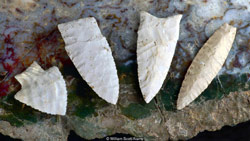
The First People Who Populated the Americas
Melissa Hogenboom, BBC
Archaeological evidence of people living in the Bluefish Caves in the northern Yukon Territory of western Canada as early as 24,000 years ago now suggests that the people who left Siberia did so 10,000 years earlier than previously thought. They remained genetically and geographically isolated in Beringia until about 16–15,000 years ago before dispersing south.

Human Milk May Solve Ice Age Evolutionary Mystery
Leslea Hlusko, RealClear Science
Finds over the past decade suggest that the urge to go to sea and the cognitive and technological means to do so predates modern humans and may have begun with Neanderthals thousands of years earlier than we thought.

Becoming Human
PBS
Unearthing our earliest ancestorsNothing is more fascinating to us than, well, us. Where did we come from? What makes us human? An explosion of recent discoveries sheds light on these questions, and NOVA’s comprehensive, three-part special, “Becoming Human,” examines what the latest scientific research reveals about our hominid relatives—putting together the pieces of our human past and transforming our understanding of our earliest ancestors.
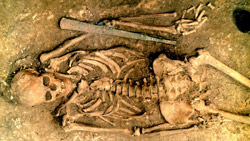
DNA Deciphers Roots of Modern Europeans
Carl Zimmer, New York Times
Studies of ancient European DNA, extracted from 170 skeletons found in countries from Spain to Russia, indicate that today’s Europeans descend from three groups who moved into Europe at different stages of history beginning with hunter-gatherers who arrived some 45,000 years ago.
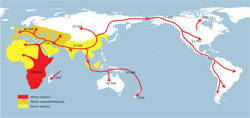
Did Modern Humans Go Global Twice As Early As Thought?
Bob Holmes, New Scientist
Stone tools dating from about 125,000 years ago excavated in the desert near the Straits of Hormuz suggest that Homo sapiens managed to spread across the world much earlier than previously thought – and it was a favorable climate, not a sophisticated culture, that allowed them to go.
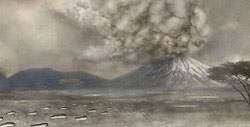
Did Dramatic Climate Instability Effect Who We Became?
Smithsonian National Museum of Natural History
Explore how environmental changes influenced evolution, and how dramatic climate instability over the past 6 million years increased our ability to adapt.
Callaway, E. “Teeth from China reveal early human trek out of Africa.” Nature, October 14, 2015.
Gray, Richard. “African tribe populated rest of the world.” The Telegraph, May 9, 2009.
Kirk, Tom. “Unprecedented study of Aboriginal Australians points to one shared Out of Africa migration for modern humans.” Phys.Org, September 22, 2016.
Malaspinas, AS., M. Westaway, C. Muller, et al. “A genomic history of Aboriginal Australia.” Nature 538, 207–214 (2016). https://doi.org/10.1038/nature18299
Mallick, S., H. Li, M. Lipson, et al. “The Simons Genome Diversity Project: 300 genomes from 142 diverse populations.” Nature 538, no. 7623 (September 21, 2016): 201–206. https://doi.org/10.1038/nature18964
Mascarelli, Amanda. “Climate Swings Drove Early Humans Out of Africa (and Back Again).” SAPIENS, September 21, 2016.
Pagani, L., Lawson, D., Jagoda, E. et al. “Genomic analyses inform on migration events during the peopling of Eurasia.” Nature 538, no. 7623 (September 21, 2016): 238–242. https://doi.org/10.1038/nature19792
Quam, Rolf. “Fossil jawbone from Israel is the oldest modern human found outside Africa.” The Conversation, January 25, 2018.
Suddendorf, Thomas. The Gap: The Science of What Separates Us from Other Animals. Basic Books, 2013.
Timmermann, Axel, and Tobias Friedrich. “Late Pleistocene Climate Drivers of Early Human Migration.” Nature 538, no. 7623 (September 21, 2016): 92–95. https://doi.org/10.1038/nature19365
Vernot, Benjamin, Serena Tucci, Janet Kelso, Joshua G. Schraiber, Aaron B. Wolf, Rachel M. Gittelman, Michael Dannemann, et al. “Excavating Neandertal and Denisovan DNA from the Genomes of Melanesian Individuals.” Science 352, no. 6282 (April 8, 2016): 235–39. https://doi.org/10.1126/science.aad9416
Zhang, Yulin, et al. “Recovering Signatures of Archaic Hominin Introgression Using Ancestral Recombination Graphs.” Science, vol. 393, no. 6814, Aug, 2026. https://doi.org/10.1126/science.aef8874
Zimmer, Carl. “Oldest Fossils of Homo Sapiens Found in Morocco, Altering History of Our Species.” New York Times, June 7, 2017.