Becoming Human
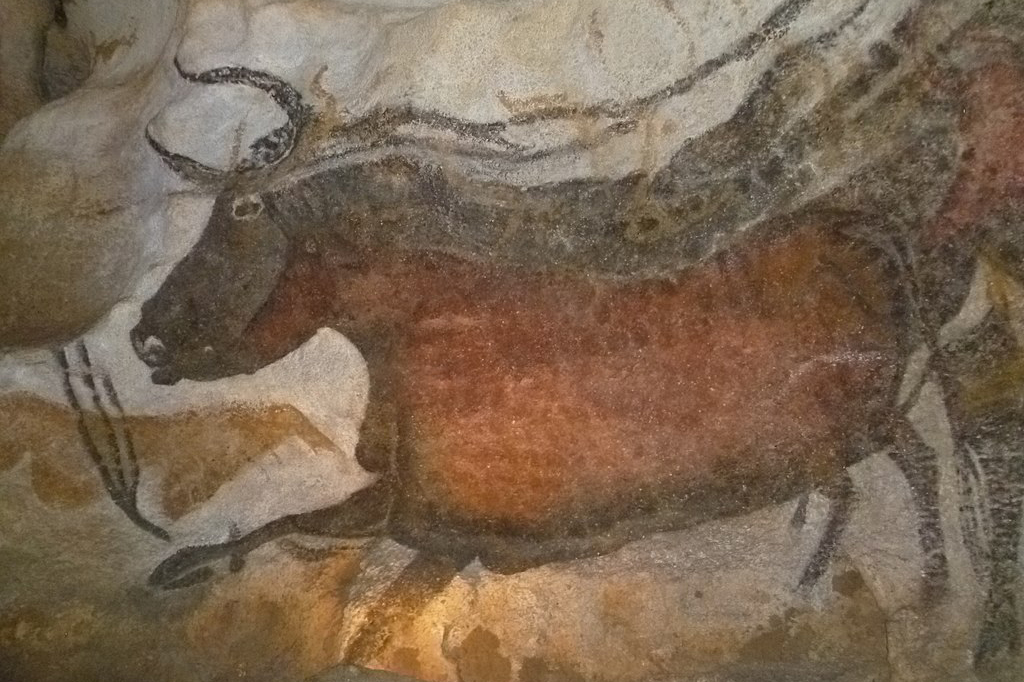
Cave Painting, Lascaux France. Jo Jan via Wikimedia Commons.
The evolution of our journey to become modern human, capable of abstract and symbolic thought, was a long one—it may well have taken more than 500,000 years!
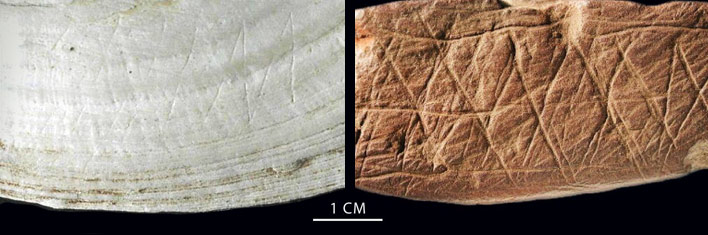
The earliest known example of deliberate patterns made by ancient humans predates Paleolithic cave art by several hundred thousand years. Identified in 2014 by an international team of scientists, a zig-zag patterned shell was carbon-dated to as far back as 430,000–540,000 years ago, which discounts the possibility that it was made by either Neanderthals or modern humans.
The shell was actually found in 1891 on the Indonesian island of Java by the Dutch paleontologist Eugène Dubois who discovered “Java Man,” now known as Homo erectus. It took 123 years, great advances in technology, and perhaps a change of expectation and attitude about our place in the world, before we were able to entertain the idea that abstract thought and the expression of it might possibly have existed in our pre-human ancestors—and to recognize that these shell markings were deliberately made.
Such deliberate markings were until then thought to be indicative exclusively of modern cognition and behavior, originating with Homo sapiens in Africa. This find was at least four times older than what was previously the oldest known etched artefact—geometric carvings in a sample of ochre found in South Africa’s Blombos Cave. This meant the shell engravings would have to have been made by our pre-Neanderthal ancestor, Homo erectus, and pushed the origin of the ability to deliberately engrave back by at least 300,000 years.
From about 40–35,000 years ago, and over the next 25,000 years, throughout the last major Ice Age, our ancestors’ artistic expressions reached a critical mass and spread not only all over Europe, Asia and Siberia but also appeared in Australia and Africa—throughout the old world.
Within this long period our early ancestors first recognized symbolic representation: the Acheulian figurine Tan-Tan (500,000–300,000 years old), to date the oldest known hominid representation, and the Berekhat Ram female figurine from Israel (250,000–280,000 years old) both appear to have been created by nature, but then manually modified in places. They were the first steps to creating three-dimensional portable art that would become prevalent during the Paleolithic period.
A Creative Explosion
About 45,000 years ago Cro-Magnon developed blades and spear-throwers with a considerably greater range, velocity and penetration than earlier examples so far found. Hunters could now kill large animals from a longer, much safer, distance. With these new creative inventions, diet improved, more people survived—with much more contact between bands. Hunting technologies were quite possibly shared between groups, and so methods and tools evolved rapidly as human migrations followed reindeer and bison.
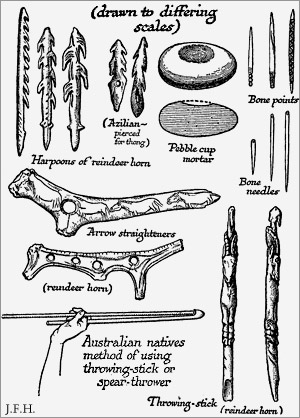
Over this period our ancestors invented burins to help make tools from antlers, such as bone spears and harpoons that were often beautifully engraved and carved. They crafted small bone needles from which to fashion vital, multilayered clothing for insulation and to survive the extreme temperature fluctuations. Ornamentation symbols of kinships, status and collective identity have been found from this period.
Venus figurines dating from this same period have been found over an expanse of territory from the west of Europe into Russia. This suggests that people were linked across these vast distances, communicating and developing social relationships that would be advantageous at a time when food resources were limited or depleted in specific areas.
The Earliest Figurative Rock Art
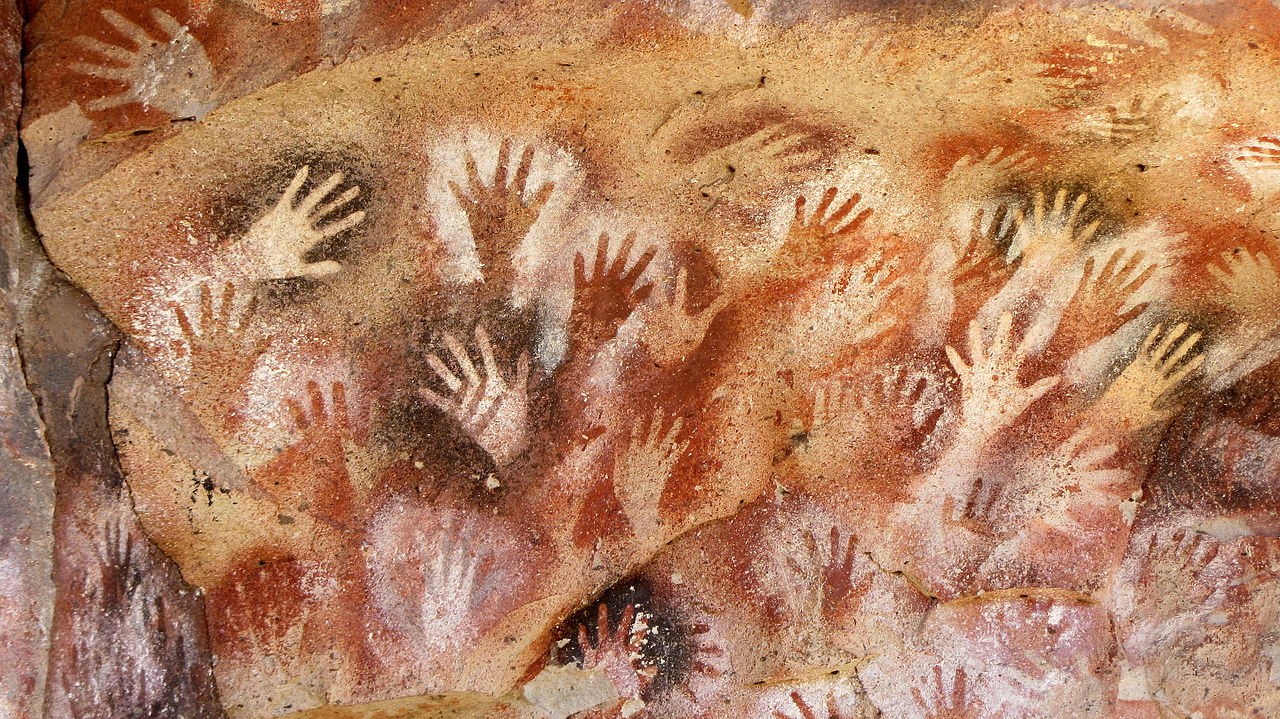
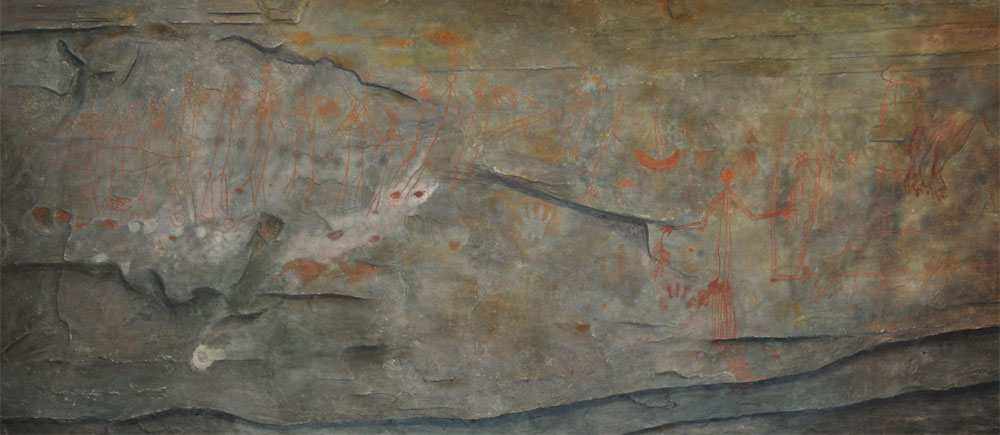
From about 40–35,000 years ago, and over the next 25,000 years, throughout the last major Ice Age, our ancestors’ artistic and creative expressions reached a critical mass and spread not only all over Europe, Asia and Siberia but also appeared in Australia and Africa—throughout the old world.
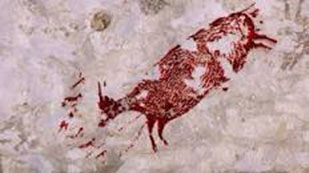
For example, 40,000 years ago—at the same time as our early European ancestors began to create the well-known European cave paintings—people 13,000 kilometers away in the Indonesian province of South Sulawesi were also producing figurative paintings on cave walls.
By 35,000 years ago, the capacity for abstract thought and symbolic representation had finally become a stable and universal capacity of the human mind and one of the traits that we share with all other humans. It enabled us to communicate in unprecedented ways and build the world we know today.
We were the same human beings then as we are now.

Giant Cave of Prehistoric Art Has Been Hidden Since the Stone Age
Science Alert
For the past 24,000 years or so, a hidden sanctuary of Paleolithic rock art has endured on the walls of a cave near Valencia in eastern Spain, holding clues about the ancient artists and the world they inhabited.

Proof of Stone Age humans building wooden structures uncovered by archaeologists
Nation CYMRU
Humans were building structures from wood earlier than had been thought possible, according to archaeologists who have uncovered evidence from almost half a million years ago.
▶ Video
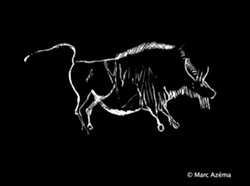
Prehistoric Animations Emerge from Cave Walls
New Scientist
Paleolithic animated pictures.

The Chauvet-Pont d’Arc Cave
Musée d’Archéologie nationale
Take a virtual tour of the cave.
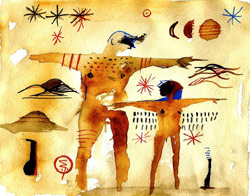
Why do We Tell Stories? Hunter-gatherers Shed Light on the Evolutionary Roots of Fiction
Daniel Smith, The Conversation
Given the ubiquity of storytelling, it may perform an important adaptive role in human societies by broadcasting social norms to coordinate social behavior and promote cooperation.
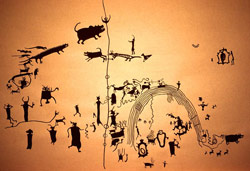
The Dawn of Prehistoric Rock Art
James Q. Jacobs
With recent cave art discoveries and the accurate dating of the rock paintings, our concepts of human evolution have undergone significant transformations.
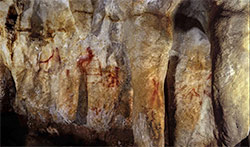
Neanderthals—Not Modern Humans—Were First Artists on Earth, Experts Claim
Ian Sample, The Guardian
Neanderthals painted on cave walls in Spain 65,000 years ago – tens of thousands of years before modern humans arrived.
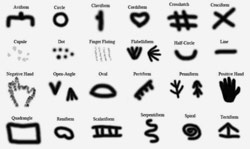
Messages from the Stone Age
Robin McKie, The Guardian
In Chauvet and Lascaux caves 26 specific signs are used repeatedly. These markings are no mere abstract scribbles but appear to be a code that was painted on to rock by the Cro-Magnon people, who lived in Europe 30,000 years ago.
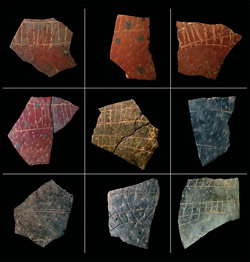
Stone Age Engravings Found on Ostrich Shells
Bruce Bower, Wired
60,000-year-old ostrich eggshells engraved with geometric designs demonstrates the existence of a symbolic communication system among Stone Age hunter-gatherers.
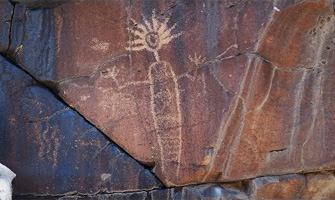
▶ Video
Talking Stone–Rock Art of the Cosos
Paul Goldsmith, ASC and Alan P. Garfinkel
Hidden away in the canyons of a top secret military base on the edge of the Mojave Desert is the largest concentration of rock art in North America. Created over thousands of years by a now vanished culture, it represents the oldest art in California. Talking Stone explores the remote canyons and mysteries surrounding these amazing images.
Bradshaw Foundation. “Tan-Tan: the oldest known human representation?”. Accessed October 17, 2024. https://www.bradshawfoundation.com/sculpture/tan_tan.php
Bradshaw Foundation. “Berekhat Ram: Oldest known representation of a woman?” Accessed October 17, 2024. https://www.bradshawfoundation.com/sculpture/berekhat_ram.php
Kohut, Meridith, “Cave Artists of Sulawesi.” AramcoWorld, April 2015. Video, 8 min., 58 sec. https://www.aramcoworld.com/Resources/Video/2018/Cave-Artists-of-Sulawesi