
Recursive Thinking and the Rise of Language
Image: Wikiart
All humans are born with the ability to speak and think recursively. But our individual languages are unique, adaptive tools, each one shaped and modified by the environment in which it developed. The language we are born with and the way we write it influences how we perceive time in space and how we remember events.
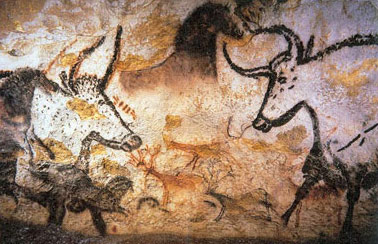
The symbolic creations of the Upper Paleolithic period that we marvel at on cave walls represented a new ability to express experiences and ideas exterior to oneself in two-dimensional art. This new ability would lead to our complex writing and numerical systems and to the development of the numerous external memory records and cultural products which proliferate in the world today.
Thought, Brain Size, and Physiology—an Evolutionary Feedback Loop
These transformations required an acceleration in brain development which Merlin Donald and others believe can be explained by the brain’s “plasticity”—its potential for functional adaptation. This quality enabled brain development to proceed at a rate far in excess of the relatively slow pace of genetic evolution.
The transition from speech to external symbols may well have caused a feedback loop where developments in language themselves stimulated biological changes, and these changes further changed our biology. A study led by anthropologist John Hawks concluded that in the last 5,000 to 10,000 years, as agriculture was able to support increasingly large societies, the rate of evolutionary change in human genetics was more than 100 times faster than before. And the genes related to brain development were evolving fastest.
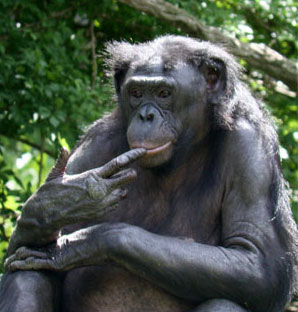
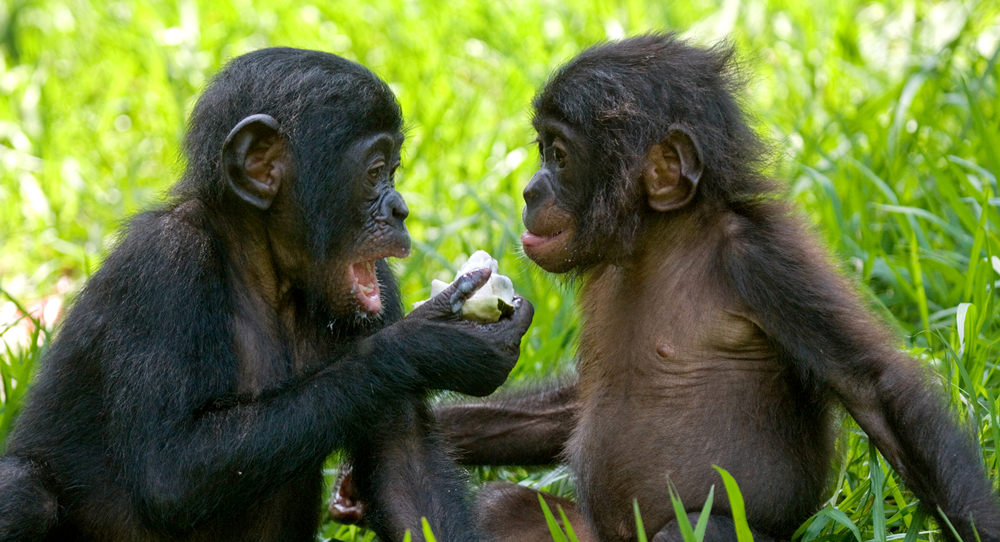
Thanks to the work of Sue Savage-Rumbaugh and others, we know that captive apes who have been taught sign language can communicate about past events, future plans and abstract ideas with their trainers, as well as interpret pictures, enjoy humor, and display other human-like mental skills.
Captive gorillas may acquire new modes of thinking in the process of learning sign language, but it’s unlikely that these developed exclusively because of the training. As we have seen, apes gesture intentionally; bonobos and chimps show some degree of future-thinking and mind-reading even in the wild. In these circumstances, thought does precede its expression. The language ability of apes may well be a protolanguage originally shared by our ancestors—a precursor of our own ability.
In 2006 psychologist Daniel B. Haun and colleagues set out to find out whether we have a biologically evolved preference for representing space relative to ourselves—that is, egocentrically—or independently of ourselves, relative to features of the external world—allocentrically.
Haun et al’s experiments led them to propose that we share with the other great apes an inherited preference for the allocentric system. Studies suggest that even before we can speak, human infants are capable of representing aspects of space independently of their own position. However, from very early in life we have access to both self-centered and environment-centered ways of representing space. Which system becomes habitual can be strongly influenced by subsequent experience, culture and language.
Cultures differ considerably in which system they encourage people to use. Haun and his colleagues’ hypothesis was that culture does not give us a new spatial ability, or remove an old one, but helps determine which of our existing abilities becomes habitual.
There is a distinction between what individuals can think about and what they can communicate. The question is how much do these two activities affect each other? Humans are born with the ability to speak. As infants we think and comprehend things about our physical world before we are able to understand specific words, and long before we can pronounce them.
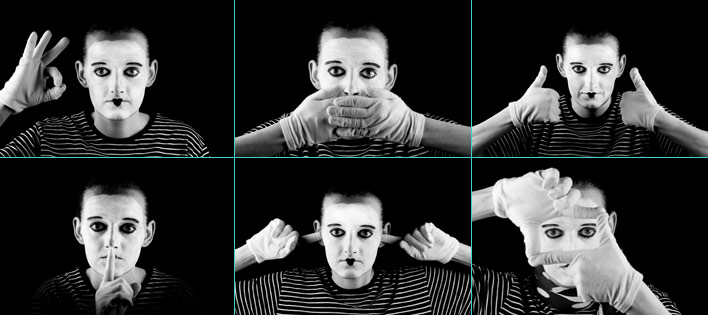
Our brains grew larger as we developed an ability to express thoughts about the past and the future through mimesis, and from this evolved our unique ability for complex recursive thought. Recursion is our ability to embed ideas within ideas. In The Recursive Mind: The Origins of Human Language, Thought, and Civilization, psychologist Michael Corballis says the ability to think recursively is the primary characteristic that distinguishes the human mind from that of other animals.
It is more than likely that only humans can remember countless episodes from the past, make numerous plans and continuously predict future situations. As we know from our favorite entertainments and, of course, from gossip, we are particularly interested in the lives of others. We need to communicate.
Language as an Adaptive Tool
As our physiology continued to change we became able to produce a great variety of sounds, which then enabled us to develop speech and to create our communities’ languages. Just as the cries of chimpanzees about their favorite fruit trees developed in response to the ecological complexity of the Taï forest of Côte d’Ivoire in West Africa, human languages too are unique, adaptive tools, each one shaped and modified by the culture in which it occurs.
Michael Corballis claims that it is the recursive nature of our memory (our ability to remember multiple past events and imagine possible future ones)—coupled with our ability to gauge what is in the mind of other individuals (their thoughts, emotions, intentions or desires)—that provided the basis for this leap.
Recursion enabled humans to understand at far greater complexity and to appreciate the connectedness of ideas, events and people. The need to share recursive ideas stimulated our need for recursion in language: to embed structures within structures to generate sentences like “Frank, who has a stall at the market, is a farmer who’s married to my friend Melanie, the woman who introduced us to Bennet just before you met Albert when we were in Newark last week having dinner at the Café Rouge.” Recursion enabled us to connect further with each other, to pass on information, and to become storytellers.
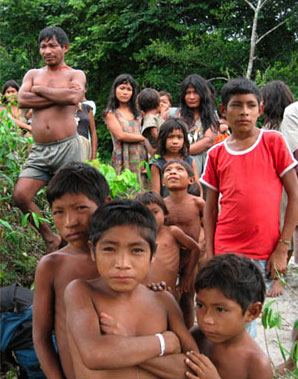
Daniel Everett’s research and work with the Pirahã, a hunter-gatherer tribe of the Brazilian Amazon, provides a good example of culture constraining language. The immediate experience is all-important to the Pirahã: they speak only of what they hear, see or infer. Although they believe in and “see” spirits that can take on the shape of animals or people or of visible, tangible things in the environment, they have no concept of a supreme spirit or god. They do not talk of the distant past so have no creation myth. Unsurprisingly their language has no past or future tense, nor is there recursion in its grammar, although they do express recursion in their stories.
Counting systems and numerical understanding appear to evolve from linguistic recursion. The Pirahã have no discrete numbers, and only three that give some notion of quantity—hói, a “small size or amount,” hoí, a “somewhat larger size or amount,” and baágiso, which can mean either to “cause to come together” or “a bunch.” The Pirahã don’t count, they don’t ask for a specific number of anything, presumably because they have never felt the necessity.
MIT professor of brain and cognitive sciences Edward Gibson and his team concluded that: “all human beings share a variety of core numerical capacities (which is probably shared with many other species as well). But both learning and using the ability to remember exact quantities larger than three or four appears to depend crucially on verbal mechanisms. Thus, languages which contain recursive count lists allow their speakers to transcend the core numerical capacities.”
To be understood by the Matses in Peru you would need to take three principal evidential distinctions into account: direct experience, inference and conjecture; and to our concept of past consider what is recent, distant or remote. David Fleck, a Peruvian linguist, ethnobiologist and zoologist who lived among the Matses for a decade or more, notes that were you to ask someone how many wives he had when his two wives were not present, his response would need to be “There were two (last time I checked).” This wouldn’t imply that he had marital problems, Matses grammar discourages one from presenting as directly established in the present something that one cannot verify in the present. Even if he saw his wives a short time ago, circumstances could theoretically have changed. An English speaker can simply report something as a fact without grammatically specifying the source of the knowledge; a Matses speaker often cannot.
One important form of allocentric representation is geocentric: locations are represented in relation to stable features or directions in the environment rather than to the observer. The Guugu Yimithirr exclusively use cardinal directions, even in confined situations where we would use body-centered directions. For instance, if they wanted someone to move aside, they might say “move a bit to the south.” If they left something in their house, they might say, “I left it on the northern edge of the western table.” Or they might warn a person to “look out for that big hole just north of your western foot.”
If you were to ask directions from a Guugu Yimithirr Aboriginal gentleman, your answer may involve him pointing to his chest, a gesture that, to an English speaker, means “me”; but for him the body isn’t the object of reference simply because it lies in the direction being indicated. As Guy Deutscher vividly puts it, the speaker can appear to point through himself “as if he were thin air.”
As a consequence of speaking a language that requires consistent attention to geographic direction they can, from our Western point of view, appear to have an extraordinarily well-developed internal compass; one we associate more with migratory birds or desert ants. But it’s evident that these people appear to have developed and maintain an ability that human beings possess but that languages and cultures like our own give us little reason to exercise.
Some geocentric languages make extensive use of environmentally anchored coordinates such as uphill/downhill, upriver/downriver, or mountainward/seaward. If we say in English “The cup is in front of the plate,” this tells us where the cup is relative to the observer’s perspective. As we’ve seen, the Guugu Yimithirr might say “The cup is north of the plate”; the Tseltal from mountainous Mexican Chiapas highlands might say “The cup is uphill of the plate,” as might the Yupno from Papua New Guinea; whereas the Mian, also from Papua New Guinea, would more likely say “The cup is upriver of the plate”; and the Tolai of New Britain in Papua would say “The cup is seaward of the plate;” in Bali, Indonesia one might say “The cup is mountainward (kaja) of the plate.”
Left, Right, and Future
The way we write our mother tongue influences how we spacialize time. English speakers tend to see the past on the left and the future on the right, whereas the reverse is generally the experience of Arabic and Hebrew speakers.
The structure of our language affects how we remember events. For example, speakers of Spanish and Japanese have a different way of describing an accidental event from events where a deliberate action is involved. If Sally broke the vase by accident, we still say: “Sally broke the vase” whereas they would say “the vase broke itself” or “the vase broke.” Lera Boroditsky, Associate Professor of Cognitive Science at UC San Diego, and her colleagues found that “Spanish and Japanese speakers were less likely to describe the accidents agentively than were English speakers, and they correspondingly remembered who did it less well than English speakers did.”
Although language certainly does not determine what colors we can see, it can influence how we notice and discriminate colors. In one study Russian speakers could of course distinguish between different shades of blue whether or not those shades had different names. But they did so more quickly when the shades belonged to the two differently named Russian categories of blue—light blue (goluboy) or dark blue (siniy).
I Like You More in Spanish
Studies of bilingual speakers came up with some startling finds. The way we feel about someone, whether we like or dislike them, depends on the language in which we are asked the question. A study by Oludamini Ogunnaike and his colleagues at Harvard and another by Shai Danziger and his colleagues at Ben-Gurion University of the Negev in Israel, looked at Arabic-French bilinguals in Morocco, Spanish-English bilinguals in the US and Arabic-Hebrew bilinguals in Israel. In each case they tested the participants’ implicit biases expressed when speaking each language. Again, according to Boroditsky who reported this: “Surprisingly, the investigators found big shifts in these involuntary, automatic biases in bilinguals depending on the language in which they were tested. The Arabic-Hebrew bilinguals, showed more positive implicit attitudes toward Jews when tested in Hebrew than when tested in Arabic.”
From these and other studies, Boroditsky and colleagues confirmed that language can change the way we think and the way we think shapes language. “It is a bidirectional cycle, and actually I think that the fact that these two things can influence each other and can exist in a mutual cycle of influence, allows humans to create complex knowledge so quickly and to be so flexible and so agile in how we think about the world.”
There are about 7,000 languages spoken in the world, each of which encompasses all the ideas, cognitive tools and predispositions of a particular culture. As Boroditsky says, “this great diversity is a real testament to the flexibility and ingenuity of the human mind. It is at the very heart of what makes us human.” Different languages and cultures provoke different habitual ways of attending to and organizing experience. However, these differences do not imprison us within specific ways of thinking; rather, they demonstrate our adaptability.
Language can influence how and what we attend to, it does not determine the boundaries of what we can think. It is our desire to connect with others and with our place in the world, which has been, and remains, the driving force behind humanity’s languages and our most important and vital necessity.
▶ Video
How the Languages We Speak Shape the Ways We Think
Lera Boroditsky, UCTV Seminars
Do speakers of different languages think differently? Does learning new languages change the way you think? Does language shape our thinking only when we’re speaking, or does it shape our attentional and cognitive patterns more broadly?
Unlike Humans, Chimpanzees Don’t Enjoy Collaborating
Danielle Venton, Wired
Chimpanzees would prefer to work alone unless a partner can help them get more food. For humans, collaboration is in itself a reward, which is likely a factor in the evolution of our language.
Bennardo, Giovanni, ed. Representing Space in Oceania: Culture in Language and Mind. Pacific Linguistics 523. Pacific Linguistics, 2002.
Boroditsky, Lera. “How Does Our Language Shape the Way We Think?” Edge.org, June 11, 2009. In What’s Next? Dispatches on the Future of Science, edited by Max Brockman. Knopf Doubleday Publishing Group, 2009.
Boroditsky, Lera. “How Language Shapes Thought.” Scientific American, February 1, 2011.
Bremner, J. Gavin. “Spatial Errors Made by Infants: Inadequate Spatial Cues or Evidence for Egocentrism?” British Journal of Psychology 69, no. 1: 77–84. 1978. https://bpspsychub.onlinelibrary.wiley.com/doi/10.1111/j.2044-8295.1978.tb01634.x
Brown, Penelope, and Stephen C. Levinson. “’Uphill’ and ‘Downhill’ in Tzeltal.” Journal of Linguistic Anthropology 3, no. 1 (1993): 46–74. https://doi.org/10.1525/jlin.1993.3.1.46.
Colapinto, John. “The Interpreter: Has a remote Amazonian tribe upended our understanding of language?“. The New Yorker, April 9, 2007.
Corballis, Michael C. The Recursive Mind: The Origins of Human Language, Thought, and Civilization. Updated Edition. Princeton University Press, 2014.
Danziger, Shai, and Robert Ward. “Language Changes Implicit Associations Between Ethnic Groups and Evaluation in Bilinguals.” Psychological Science 21, no. 6 (May 5, 2010): 799–800. https://doi.org/10.1177/0956797610371344
Deutascher, Guy. “Does Your Language Shape How You Think?“ New York Times, August 26, 2010.
Donald, Merlin. Origins of the Modern Mind: Three Stages in the Evolution of Culture and Cognition. Harvard University Press, 1993.
Everett, Daniel L. “Cultural Constraints on Grammar and Cognition in Pirahã.” Current Anthropology 46, no. 4 (August 2005): 621–46. https://doi.org/10.1086/431525
Fang, Janet. “Chimps ‘Talk’ to Each Other About Their Favorite Fruit Trees.” IFLScience, January 21, 2015.
Fedden, Sebastian, and Lera Boroditsky. “Spatialization of Time in Mian.” Frontiers in Psychology 3 (2012): 485. https://doi.org/10.3389/fpsyg.2012.00485
Fleck, David W. “Evidentiality and Double Tense in Matses.” Language 83, no. 3 (2007): 589–614. https://doi.org/10.1353/lan.2007.0113
Frank, Michael C., Daniel L. Everett, Evelina Fedorenko, and Edward Gibson. “Number as a Cognitive Technology: Evidence from Pirahã Language and Cognition.” Cognition 108, no. 3 (September 2008): 819–24. https://doi.org/10.1016/j.cognition.2008.04.007
Harvard University. “Language may help create, not just convey, thoughts and feelings.” ScienceDaily, November 17, 2010.
Haun, D. B. M., C. J. Rapold, J. Call, G. Janzen, & S. C. Levinson. “Cognitive cladistics and cultural override in Hominid spatial cognition.” Proceedings of the National Academy of Sciences, 103(46), 17568–17573. 2006. DOI: 10.1073/pnas.0607999103
Haun, D. B. M., Call, J., Janzen, G., & Levinson, S. C. “Evolutionary Psychology of Spatial Representations in the Hominidae.” Current Biology, 16(17), 1736–1740. 2006. DOI: 10.1016/j.cub.2006.07.049
Haviland, John B. “Anchoring, Iconicity, and Orientation in Guugu Yimithirr Pointing Gestures.” Journal of Linguistic Anthropology 3, no. 1 (1993): 3–45. https://doi.org/10.1525/jlin.1993.3.1.3.
Hawks, John. “Longer Time Scale for Human Evolution.” Proceedings of the National Academy of Sciences 109, no. 39 (September 14, 2012): 15531–32. https://doi.org/10.1073/pnas.1212718109
Huttenlocher, Janellen, Nora S. Newcombe, and E. H. Sandberg. “The Coding of Spatial Location in Young Children.” Cognitive Psychology 27, no. 2 (1994): 115–47. https://www.sciencedirect.com/science/article/abs/pii/S0010028584710140
Huttenlocher, Janellen. “Coding Location: The View from Toddler Studies.” American Psychologist 63, no. 8 (2008): 641–48. https://doi.org/10.1037/0003-066X.63.8.641.
Kaplan, Karen. “Study finds humans still evolving, and quickly.” Los Angeles Times, March 4, 2013.
Levinson, Stephen C. “Language and Cognition: The Cognitive Consequences of Spatial Description in Guugu Yimithirr.” Journal of Linguistic Anthropology 7, no. 1 (1997): 98–131. https://doi.org/10.1525/jlin.1997.7.1.98.
Levinson, Stephen C. “Language and Space.” Annual Review of Anthropology 25 (1996): 353–82. https://doi.org/10.1146/annurev.anthro.25.1.353
Levinson, Stephen C. Space in Language and Cognition: Explorations in Cognitive Diversity. Cambridge University Press, 2003.
Lew, Adina R., J. Gavin Bremner, and L. Lefkovitch. “The Development of Relational Landmark Use in 6- to 12-Month-Old Infants in a Spatial Orientation Task.” Child Development 71, no. 5 (2000): 1179–90. https://doi.org/10.1111/1467-8624.00222
Newcombe, Nora S., Janellen Huttenlocher, Anna Bullock Drummey, and Judith G. Wiley. “The Development of Spatial Location Coding: Place Learning and Dead Reckoning in the Second and Third Years.” Cognitive Development 13, no. 2 (1998): 185–200. https://doi.org/10.1016/s0885-2014(98)90038-7
Ogunnaike, Oludamini, Yarrow Dunham, and Mahzarin R. Banaji. “The Language of Implicit Preferences.” Journal of Experimental Social Psychology 46, no. 6 (November 2010): 999–1003. https://doi.org/10.1016/j.jesp.2010.07.006
Pederson, Eric, Eve Danziger, David Wilkins, Stephen C. Levinson, Sotaro Kita, and Gunter Senft. “Semantic Typology and Spatial Conceptualization.” Language 74, no. 3 (1998): 557–89. DOI:10.2307/417793
Senft, Gunter. “Absolute Frames of Spatial Reference in Austronesian Languages.” Russian Journal of Linguistics 21, no. 4 (2017): 686–705. https://doi.org/10.22363/2312-9182-2017-21-4-686-705.