Sunlight and Darkness in China
Image: Wikimedia Commons
For ten weeks in the summer of 2022 a brutal drought and heat wave struck an area of China larger than France, Spain, and Germany combined. It devastated farms that supply half of the country’s rice. The level of the Yangtze River, the largest and most important river in the nation, fell so low that 400 million people had their drinking water limited. Dams could no longer operate their generators, causing blackouts as electricity demand soared from air conditioning use. For days many large cities experienced temperatures over 43°C (110°F). There is no doubt that the magnitude of this catastrophe resulted from the changing climate.
China’s energy use is now by far the greatest threat to Earth’s climate future.
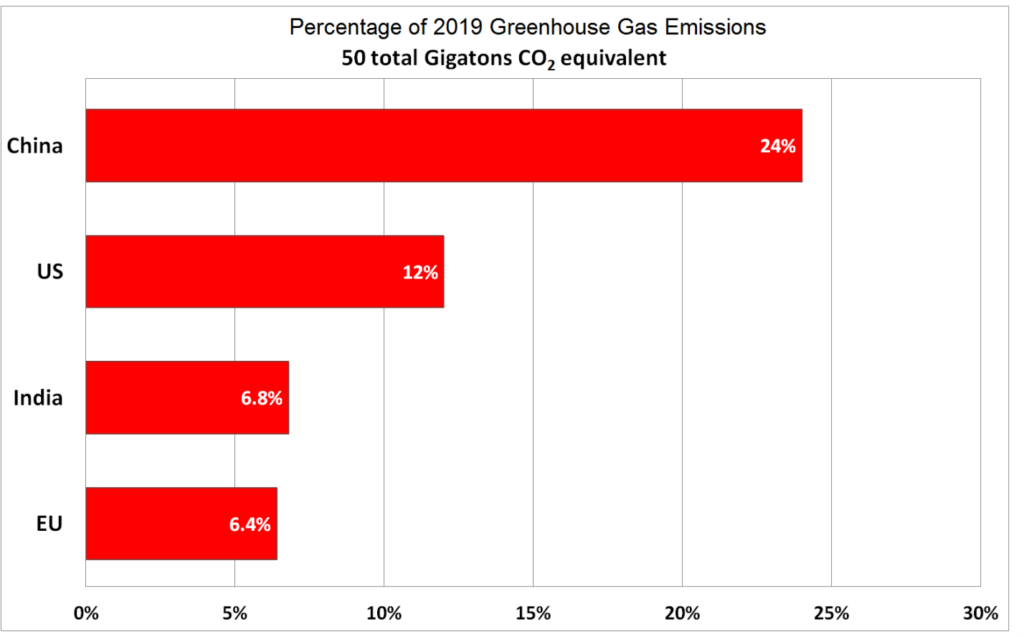
The government and the people of China are well aware of the threat of global warming. Even so, China’s energy use is now by far the greatest threat to Earth’s climate future. The government’s response to the economic harm done from the drought was to increase energy supplied from burning coal. China mines and burns more coal than any other nation, with over a thousand coal-fired power plants. As a result, China now emits more man-made greenhouse gases than the United States, Europe and Japan combined. China makes more than half of the world’s steel and cement, and the emissions from just those two industries alone are higher than the European Union’s total CO2 output.
Guilty as Charged?
But look a bit deeper and China’s responsibility for its emissions becomes more complicated. Perhaps a quarter of China’s CO2 emissions come from making goods exported to Japan and the West.
But look a bit deeper and China’s responsibility for its emissions becomes more complicated. Perhaps a quarter of China’s CO2 emissions come from making goods exported to Japan and the West. And many of those goods are made by international manufacturers located in China to take advantage of its permissive environmental laws. These manufacturers include suppliers for foreign-owned “big-box” stores, well-known merchandise brands, and high-tech products, particularly for the US market. So in a sense Western nations have exported much of their greenhouse gas emissions to China. China could of course tighten its environmental regulations but other developing economies would be more than willing to then step into this role.
The Chinese regard their greenhouse gas emissions as an unavoidable cost of providing basic living standards.
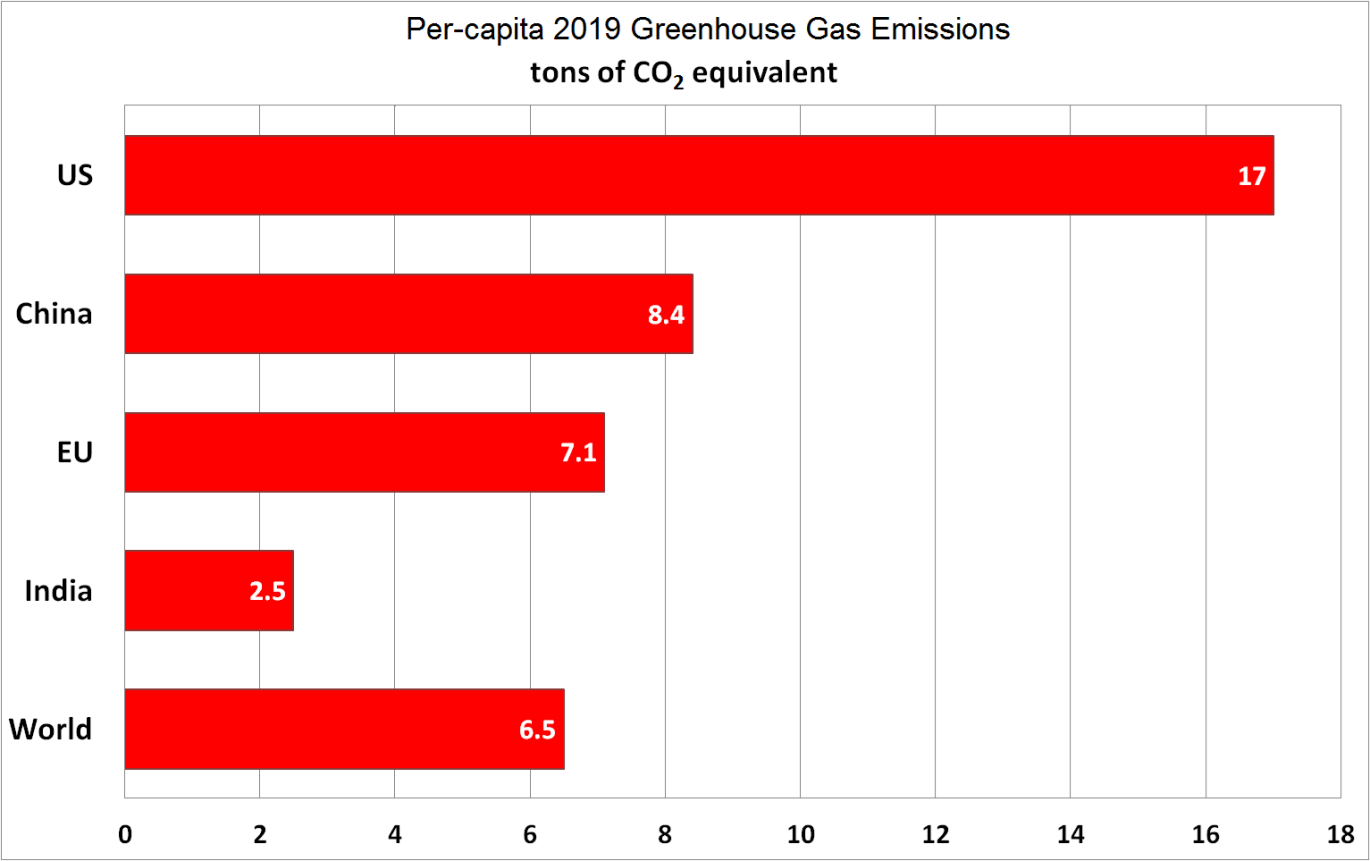
China’s policies are also influenced by its history of extreme poverty. Within living memory the Chinese government has raised millions of its people from misery and disease into new lives of hope and well-being. For this extraordinary accomplishment, unequaled in history, it has relied on cheap energy obtained from plentiful supplies of coal. But even today China’s per-capita production of greenhouse gases is only about half that of the United States or Canada. The Chinese regard their greenhouse gas emissions as an unavoidable cost of providing basic living standards, while the emissions of Western nations and the US especially are seen as lifestyle choices. Most of the gases now warming the planet were emitted by Western nations as they became wealthy, and the Chinese refuse to accept these nations telling China it cannot do the same.
Biting One’s Own Ear
China’s per-capita production of greenhouse gases is only about half that of the United States or Canada.
But as China saw in the summer of 2022, climate disasters do not distinguish between the exploiter and the exploited. And as always, in China as everywhere else, it is the poorest who suffer the most.
The Chinese heat wave and drought of 2022 were extreme but not unique. The country faces a growing water shortage, not least because its many coal-fired plants consume 15% of its total annual water use. China has lost more arable land to desertification than an area equal to all of its farmland. Dust storms originating in Gobi desert in northern China are so common and widespread that they cause asthma and respiratory disease in Japan and Korea when the dust blows east. According to the World Bank, China’s infamous air pollution kills 750,000 of its people every year. Even though the Chinese government limits protest, significant pollution events have sparked widespread angry demonstrations.
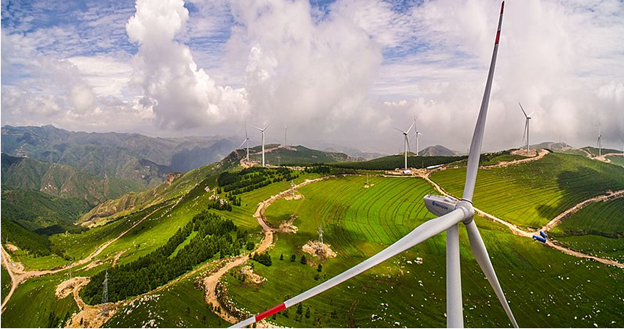
The government is not insensitive to environmental harm or the threat it poses to the climate. Perhaps even more, it appreciates the economic and strategic benefits of renewable energy. Per unit of power the total cost of building a new solar plant in China is now less than that of building a coal-fired plant. Renewable energy offers true energy independence—it needs no fuel imports—which is an attractive prospect for a nation seeking to exclude foreign influence. And China’s excellent manufacturing facilities position it to be the renewable energy supplier to the world: it currently makes half of the world’s wind turbines, two-thirds of its solar modules, and close to all of its storage batteries. China was expected to export $100 billion dollars worth of renewable energy equipment in 2022.
Better and Worse Than All Others
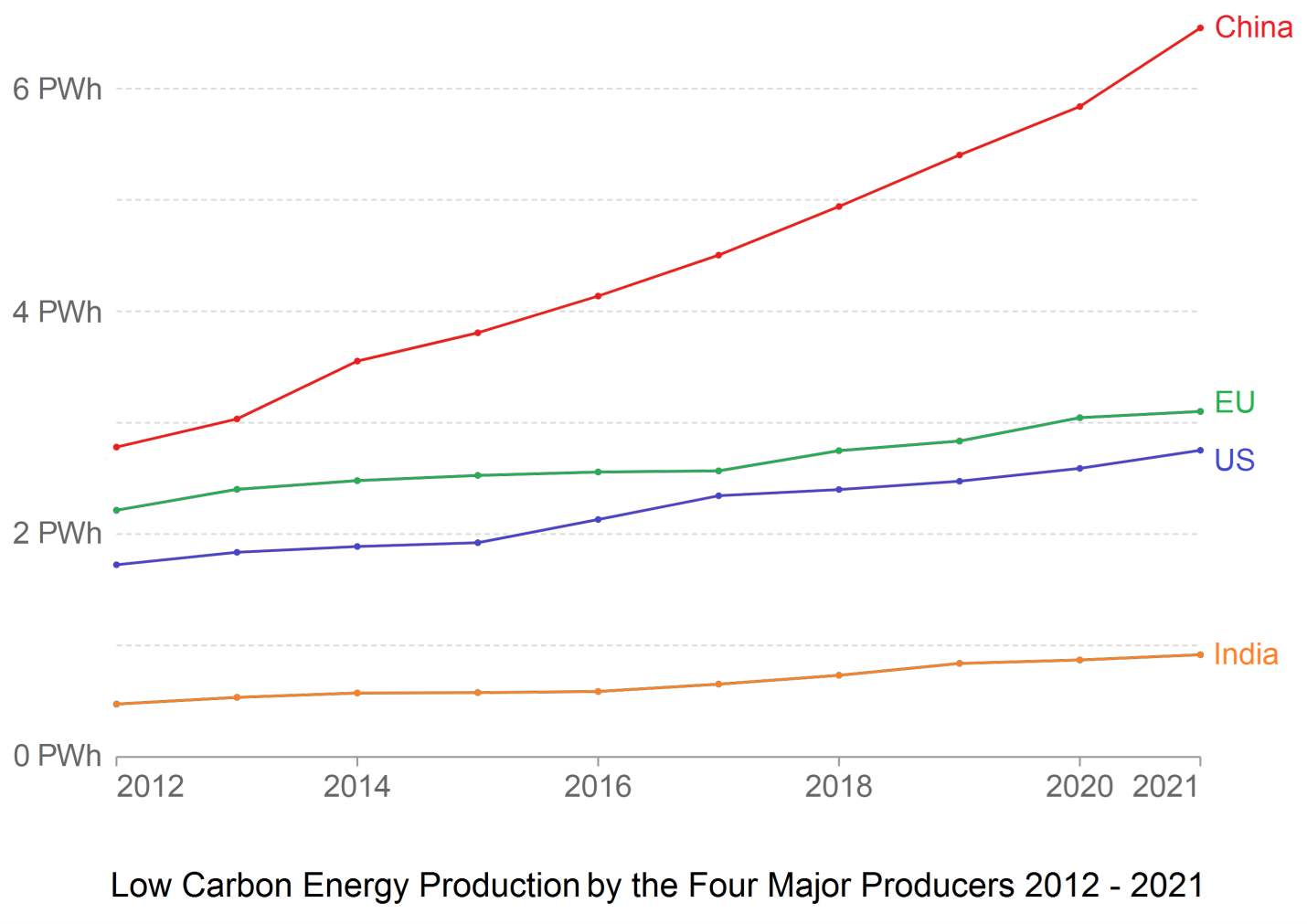
In recent years China has installed as much renewable energy as the rest of the world combined. It has more than twice the wind power of the United States and will soon have three times as much. It already has three times the photovoltaic generation. Since 2012, China has more than doubled its renewable energy use. This is particularly impressive since it already had by far the world’s largest renewable energy base. China also leads the world in modernizing its electrical grid, essential for distributing power from widely dispersed renewable sources and for storing energy for when renewable power is low.
By all accounts the spike in China’s coal consumption is likely to be temporary. China has promised net carbon emissions will peak before 2030 and then shrink to zero by 2060. It is critical to anyone born in this century that China keeps this promise. There is good reason to distrust the Chinese government in many areas, but it does seem to be reliable about climate policy. If this commitment is duplicated in India, Europe and the United States, the world would be well on its way to doing what is needed to prevent a climate disaster. Furthermore, energy would be cheaper, much cleaner, and more available in the poorest nations. They might even follow in China’s path to prosperity.
Editorial staff. “750,000 a year killed by Chinese pollution.” The Ecologist, July 3, 2007.
Evans, Damon. “China to export $100bn in renewable energy technology in 2022, bright future ahead.” Energy Voice, July 27, 2022.
Gold Roberts, Alli. “Calculating China’s carbon emissions from trade.” MIT News, March 6, 2014.
International Energy Agency. Energy Technology Perspectives 2023. IEA, 2023. Available online at https://www.iea.org/reports/energy-technology-perspectives-2023, Licence: CC BY 4.0.
Liu, Coco. “Water Demands of Coal-Fired Power Drying Up Northern China.” Scientific American, March 25, 2013.
Liu, Hongqiao, Simon Evans, Zizhu Zhang, Wanyuan Song, and Xiaoying You. “The Carbon Brief Profile: China.” Carbon Brief, November 30, 2023.
McGrath, Matt. “Climate change: China aims for ‘carbon neutrality by 2060’.” BBC News, September 22, 2020.
Meredith, Robyn. “China Changes the Climate Debate.” Forbes, September 2, 2009.
Regan, Helen, and Carlotta Dotto. “US vs. China: How the world’s two biggest emitters stack up on climate.” CNN, November 3, 2021.
Wikipedia contributors. “Pollution in China.” Wikipedia, The Free Encyclopedia. Accessed June 25, 2025.