
Ancient China:
Early Civilizations China
There is no historical evidence, archaeological or otherwise, that supports ancient Chinese history, from the Three Sage Kings to the end of the Hsia Dynasty. We know of only two written histories about the period in question (from 2800 BCE), but neither of these were written contemporaneously. The Records of the Grand Historian was written in the 2nd century BCE by the court astrologer and historiographer Sima Qian, and the Bamboo Annals, a set of Chinese court records originally written on bamboo slips during the Warring States period (475–221 BCE), the text of which is known today in two versions, a “current text” of disputed authenticity and an incomplete “ancient text.”
Whether based on historical fact or myth, the stories of these ancient monarchs held important symbolic value for the Chinese. Like the Homeric legends of ancient Greece, these tales became a cultural memory, explaining how and why their societies evolved and providing standards by which later people could judge their own values and behavior.
There are many variations of who was classified as the Three Sovereigns or the Five Emperors. The Records of the Grand Historian by Sima Qian states that these were:
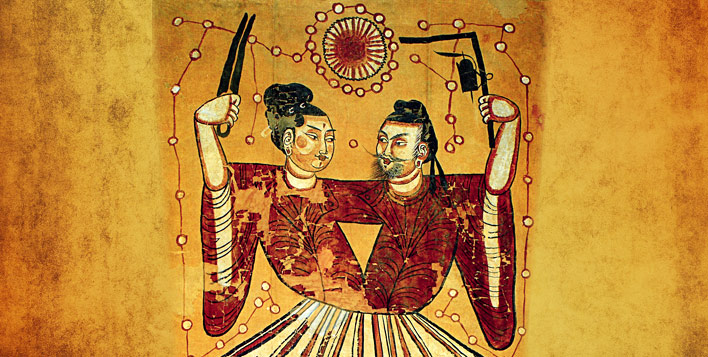
- Fuxi: The Heavenly Sovereign—ruled for 18,000 years
- NuWa: The Earthly Sovereign—ruled for 11,000 years
- Shenong: The Human Sovereign—ruled for 45,600 years
Followed by:
- The Yellow Emperor
- Emperor Zhuanxu
- Emperor Ku
- Emperor Yao
- Emperor Shun
Legge, James. The Chinese Classics. J.B. Lippincott & Company, 1876.
Pei, Yin, Active 438 Contributor, Qian Sima, and Zhen Sima. Shi Ji: Yi Bai San Shi Juan. Jianyang, Fujian Province: Cai Mengbi, 1171. Pdf. https://www.loc.gov/item/2021666519/